Posts

Showing posts with the label Hubble

FREE download collection "NASA - best photos". January - June, 2019.

Image
FREE download collection "NASA - best photos". January - June, 2019. Hello everyone! FREE download my collection "NASA - best photos"! January - June, 2019 1 ZIP file 1.20 Gb Free download link: https://drive.google.com/open?id=1NwHSrNDAZ4I52BWIa6s7lHGY11WGn1m7   Our YouTube channel: https://www.youtube.com/watch?v=l8yqBrxUj8Y === #NASA #space #photonews

NASA PhotoNews: The Great Carina Nebula

Image
NASA PhotoNews: The Great Carina Nebula Image Credit & Copyright: Maicon Germiniani Explanation: A jewel of the southern sky, the Great Carina Nebula, also known as NGC 3372, spans over 300 light-years, one of our galaxy's largest star forming regions. Like the smaller, more northerly Great Orion Nebula, the Carina Nebula is easily visible to the unaided eye, though at a distance of 7,500 light-years it is some 5 times farther away. This gorgeous telescopic close-up reveals remarkable details of the region's central glowing filaments of interstellar gas and obscuring cosmic dust clouds. The field of view is over 50 light-years across. The Carina Nebula is home to young, extremely massive stars, including the stars of open cluster Trumpler 14 (above and left of center) and the still enigmatic variable Eta Carinae, a star with well over 100 times the mass of the Sun. Eta Carinae is the brightest star, centered here just below the dusty Keyhole Nebula (NGC 3324). While...

NASA PhotoNews: NGC 6357: The Lobster Nebula.

Image
NASA PhotoNews:  NGC 6357: The Lobster Nebula Image Credit: Dean Carr Explanation: Why is the Lobster Nebula forming some of the most massive stars known? No one is yet sure. Cataloged as NGC 6357, the Lobster Nebula houses the open star cluster Pismis 24 near its center -- a home to unusually bright and massive stars. The overall blue glow near the inner star forming region results from the emission of ionized hydrogen gas. The surrounding nebula, featured here, holds a complex tapestry of gas, dark dust, stars still forming, and newly born stars. The intricate patterns are caused by complex interactions between interstellar winds, radiation pressures, magnetic fields, and gravity. NGC 6357 spans about 400 light years and lies about 8,000 light years away toward the constellation of the Scorpion. === #NASA #space #photonews 18.12.26

NASA PhotoNews: M100: A Grand Design Spiral Galaxy

Image
NASA PhotoNews: M100: A Grand Design Spiral Galaxy Image Credit: NASA, ESA, Hubble Explanation: Majestic on a truly cosmic scale, M100 is appropriately known as a grand design spiral galaxy. It is a large galaxy of over 100 billion stars with well-defined spiral arms that is similar to our own Milky Way Galaxy. One of the brightest members of the Virgo Cluster of galaxies, M100 (alias NGC 4321) is 56 million light-years distant toward the constellation of Berenice's Hair (Coma Berenices). This Hubble Space Telescope image of M100 was taken recently with the Wide Field Camera 3 and accentuates bright blue star clusters and intricate winding dust lanes which are hallmarks of this class of galaxies. Studies of variable stars in M100 have played an important role in determining the size and age of the Universe. === #NASA #space #photonews 18.12.25

NASA PhotoNews: Red Nebula, Green Comet, Blue Stars

Image
NASA PhotoNews: Red Nebula, Green Comet, Blue Stars Image Credit & Copyright: Tom Masterson (Grand Mesa Observatory) Explanation: This festively colored skyscape was captured in the early morning hours of December 17, following Comet Wirtanen's closest approach to planet Earth. The comet was just visible to the eye. The lovely green color of its fluorescing cometary atmosphere or coma is brought out here only by adding digital exposures registered on the comet's position below the Pleiades star cluster. The exposures also bring out blue starlight reflected by the dust clouds surrounding the young Pleiades stars. Gaze (toward the left) across dusty dark nebulae along the edge of the Perseus molecular cloud and you'll travel to emission nebula NGC 1499, also known as the California nebula. Too faint for the eye, the cosmic cloud's pronounced reddish glow is from electrons recombining with ionized hydrogen atoms. Around December 23rd, Comet Wirtanen should be e...

NASA PhotoNews: M31: The Andromeda Galaxy

Image
NASA PhotoNews: M31: The Andromeda Galaxy Image Credit & Copyright: Robert Gendler Explanation: What is the nearest major galaxy to our own Milky Way Galaxy? Andromeda. In fact, our Galaxy is thought to look much like Andromeda. Together these two galaxies dominate the Local Group of galaxies. The diffuse light from Andromeda is caused by the hundreds of billions of stars that compose it. The several distinct stars that surround Andromeda's image are actually stars in our Galaxy that are well in front of the background object. Andromeda is frequently referred to as M31 since it is the 31st object on Messier's list of diffuse sky objects. M31 is so distant it takes about two million years for light to reach us from there. Although visible without aid, the featured image of M31 is a digital mosaic of 20 frames taken with a small telescope. Much about M31 remains unknown, including exactly how long it will be before it collides with our home galaxy. === #NASA #space #p...

NASA PhotoNews: M43 - Orion Falls

Image
NASA PhotoNews: M43: Orion Falls Image Credit & Copyright: Zhuoqun Wu, Chilescope Telescope 2 Explanation: Is there a waterfall in Orion? No, but some of the dust in M43 appears similar to a waterfall on Earth. M43, part of the Orion Molecular Cloud Complex, is the often imaged but rarely mentioned neighbor of the more famous M42. M42, which includes many bright stars from the Trapezium cluster, lies above the featured scene. M43 is itself a star forming region and although laced with filaments of dark dust, is composed mostly of glowing hydrogen. The entire Orion field, located about 1600 light years away, is inundated with many intricate and picturesque filaments of dust. Opaque to visible light, dark dust is created in the outer atmosphere of massive cool stars and expelled by a strong outer wind of protons and electrons. === #NASA #space #photonews 18.12.12

NASA PhotoNews: Arp 188 and the Tadpole's Tail

Image
NASA PhotoNews: Arp 188 and the Tadpole's Tail Image Credit: Hubble Legacy Archive, ESA, NASA; Processing: Faus Márquez (AAE) Explanation: Why does this galaxy have such a long tail? In this stunning vista, based on image data from the Hubble Legacy Archive, distant galaxies form a dramatic backdrop for disrupted spiral galaxy Arp 188, the Tadpole Galaxy. The cosmic tadpole is a mere 420 million light-years distant toward the northern constellation of the Dragon (Draco). Its eye-catching tail is about 280 thousand light-years long and features massive, bright blue star clusters. One story goes that a more compact intruder galaxy crossed in front of Arp 188 - from right to left in this view - and was slung around behind the Tadpole by their gravitational attraction. During the close encounter, tidal forces drew out the spiral galaxy's stars, gas, and dust forming the spectacular tail. The intruder galaxy itself, estimated to lie about 300 thousand light-years behind the ...

NASA PhotoNews: The Fairy of Eagle Nebula

Image
NASA PhotoNews: The Fairy of Eagle Nebula Image Credit: NASA, ESA, The Hubble Heritage Team, (STScI/AURA) Explanation: The dust sculptures of the Eagle Nebula are evaporating. As powerful starlight whittles away these cool cosmic mountains, the statuesque pillars that remain might be imagined as mythical beasts. Featured here is one of several striking dust pillars of the Eagle Nebula that might be described as a gigantic alien fairy. This fairy, however, is ten light years tall and spews radiation much hotter than common fire. The greater Eagle Nebula, M16, is actually a giant evaporating shell of gas and dust inside of which is a growing cavity filled with a spectacular stellar nursery currently forming an open cluster of stars. This great pillar, which is about 7,000 light years away, will likely evaporate away in about 100,000 years. The featured image in scientifically re-assigned colors was released in 2005 as part of the fifteenth anniversary celebration of the launch of...

NASA PhotoNews: IC 1871. Inside the Soul Nebula

Image
NASA PhotoNews: IC 1871. Inside the Soul Nebula Image Credit & Copyright: Mark Hanson Explanation: This cosmic close-up looks deep inside the Soul Nebula. The dark and brooding dust clouds on the left, outlined by bright ridges of glowing gas, are cataloged as IC 1871. About 25 light-years across, the telescopic field of view spans only a small part of the much larger Heart and Soul nebulae. At an estimated distance of 6,500 light-years the star-forming complex lies within the Perseus spiral arm of our Milky Way Galaxy, seen in planet Earth's skies toward the constellation Cassiopeia. An example of triggered star formation, the dense star-forming clouds of IC 1871 are themselves sculpted by the intense winds and radiation of the region's massive young stars. The featured image appears mostly red due to the emission of a specific color of light emitted by excited hydrogen gas. === #NASA #space #photonews 18.11.28

NASA PhotoNews: Portrait of NGC 281

Image
NASA PhotoNews: Portrait of NGC 281 Image Credit & Copyright: Jeremiah Roth Explanation: Look through the cosmic cloud cataloged as NGC 281 and you might miss the stars of open cluster IC 1590. Still, formed within the nebula that cluster's young, massive stars ultimately power the pervasive nebular glow. The eye-catching shapes looming in this portrait of NGC 281 are sculpted dusty columns and dense Bok globules seen in silhouette, eroded by intense, energetic winds and radiation from the hot cluster stars. If they survive long enough, the dusty structures could also be sites of future star formation. Playfully called the Pacman Nebula because of its overall shape, NGC 281 is about 10,000 light-years away in the constellation Cassiopeia. This sharp composite image was made through narrow-band filters. It combines emission from the nebula's hydrogen and oxygen atoms to synthesize red, green, and blue colors. The scene spans well over 80 light-years at the estimated ...

NASA PhotoNews: The Tarantula Nebula

Image
NASA PhotoNews: The Tarantula Nebula Image Credit & Copyright: Peter Ward (Barden Ridge Observatory) Explanation: The Tarantula Nebula, also known as 30 Doradus, is more than a thousand light-years in diameter, a giant star forming region within nearby satellite galaxy the Large Magellanic Cloud. About 180 thousand light-years away, it's the largest, most violent star forming region known in the whole Local Group of galaxies. The cosmic arachnid sprawls across this spectacular view, composed with narrowband filter data centered on emission from ionized hydrogen atoms. Within the Tarantula (NGC 2070), intense radiation, stellar winds and supernova shocks from the central young cluster of massive stars, cataloged as R136, energize the nebular glow and shape the spidery filaments. Around the Tarantula are other star forming regions with young star clusters, filaments, and blown-out bubble-shaped clouds. In fact, the frame includes the site of the closest supernova in moder...

The Cave Nebula in Hydrogen, Oxygen, and Sulfur

Image
The Cave Nebula in Hydrogen, Oxygen, and Sulfur Image Credit & Copyright: Chuck Ayoub Explanation: What's inside this cosmic cave? A stellar nursery 10 light-years deep. The featured skyscape is dominated by dusty Sh2-155, the Cave Nebula. In the telescopic image, data taken through a narrowband filters tracks the nebular glow of hydrogen, oxygen, and sulfur, colors that together form the Hubble Palette. About 2,400 light-years away, the scene lies along the plane of our Milky Way Galaxy toward the royal northern constellation of Cepheus. Astronomical explorations of the region reveal that it has formed at the boundary of the massive Cepheus B molecular cloud and the hot, young stars of the Cepheus OB 3 association. The bright rim of ionized hydrogen gas is energized by radiation from the hot stars, dominated by the bright star just to the left of the cave entrance. Radiation driven ionization fronts are likely triggering collapsing cores and new star formation within. ...

NASA PhotoNews: The Lagoon Nebula is Stars, Gas, and Dust

Image
NASA PhotoNews: The Lagoon Nebula is Stars, Gas, and Dust Image Credit & Copyright: Nelson Ortega Explanation: The majestic Lagoon Nebula is filled with hot gas and the home for many young stars. Spanning 100 light years across while lying only about 5000 light years distant, the Lagoon Nebula is so big and bright that it can be seen without a telescope toward the constellation of the Archer (Sagittarius). Many bright stars are visible from NGC 6530, an open cluster that formed in the nebula only several million years ago. The greater nebula, also known as M8 and NGC 6523, is named "Lagoon" for the band of dust seen to the left of the open cluster's center. The featured image was taken in three colors with details are brought out by light emitted by Hydrogen. Star formation continues in the Lagoon Nebula as witnessed by the many dark dust-laden globules that exist there. === #NASA #space #photonews 18.11.12

NASA PhotoNews: NGC 6188: The Dragons of Ara

Image
NASA PhotoNews: NGC 6188: The Dragons of Ara Image Credit & Copyright: Tian Lee Explanation: Dark shapes with bright edges winging their way through dusty NGC 6188 are tens of light-years long. The emission nebula is found near the edge of an otherwise dark large molecular cloud in the southern constellation Ara, about 4,000 light-years away. Born in that region only a few million years ago, the massive young stars of the embedded Ara OB1 association sculpt the fantastic shapes and power the nebular glow with stellar winds and intense ultraviolet radiation. The recent star formation itself was likely triggered by winds and supernova explosions, from previous generations of massive stars, that swept up and compressed the molecular gas. With image data from the Chilescope Observatory, a false-color Hubble palette was used to create this gorgeous wide-field image and shows emission from sulfur, hydrogen, and oxygen atoms in red, green, and blue hues. The field of view spans ab...

NASA PhotoNews: Halo of the Cat's Eye

Image
NASA PhotoNews: Halo of the Cat's Eye Image Credit & Copyright: Data: Michael Joner (West Mountain Observatory, BYU), Romano Corradi (IAC), Hubble Legacy Archive - Processing: Robert Gendler Explanation: Not a Falcon 9 rocket launch after sunset, the Cat's Eye Nebula (NGC 6543) is one of the best known planetary nebulae in the sky. Its haunting symmetries are seen in the very central region of this composited picture, processed to reveal an enormous but extremely faint halo of gaseous material, over three light-years across. Made with data from ground- and space-based telescopes it shows the extended emission which surrounds the brighter, familiar planetary nebula. Planetary nebulae have long been appreciated as a final phase in the life of a sun-like star. But only more recently have some planetaries been found to have halos like this one, likely formed of material shrugged off during earlier active episodes in the star's evolution. While the planetary nebul...

NASA PhotoNews: NGC 1499: The California Nebula

Image
NASA PhotoNews: NGC 1499: The California Nebula Image Credit & Copyright: Bray Falls Explanation: There's even a California in space. Drifting through the Orion Arm of the spiral Milky Way Galaxy, this cosmic cloud by chance echoes the outline of California on the west coast of the United States. Our own Sun also lies within the Milky Way's Orion Arm, only about 1,500 light-years from the California Nebula. Also known as NGC 1499, the classic emission nebula is around 100 light-years long. On the featured image, the most prominent glow of the California Nebula is the red light characteristic of hydrogen atoms recombining with long lost electrons, stripped away (ionized) by energetic starlight. The star most likely providing the energetic starlight that ionizes much of the nebular gas is the bright, hot, bluish Xi Persei just to the right of the nebula. A regular target for astrophotographers, the California Nebula can be spotted with a wide-field telescope under a d...

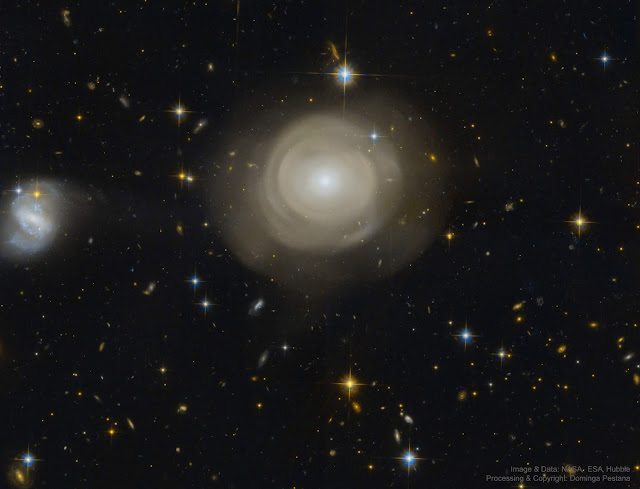
NASA PhotoNews: Shells of Stars in Elliptical Galaxy PGC 42871

Image
NASA PhotoNews: Shells of Stars in Elliptical Galaxy PGC 42871 Image Credit: Hubble Legacy Archive, NASA, ESA; Processing & Copyright: Domingo Pestana Explanation: How do galaxies grow? To help find out, the Hubble Space Telescope was deployed to image the unusual elliptical galaxy PGC 42871. How this galaxy came to be surrounded by numerous shells of stars may give clues about how it evolved. Embedded in the diffuse shells are massive globular clusters of stars -- stars which analyses show were born during three different epochs. This and other data indicate that PGC 42871 has been in at least two galactic collisions, at least one of which might have been with a former spiral galaxy. The remaining spiral galaxy on the far left is at the same distance as PGC 42871 and may have been involved in some of the collisions. PGC 42871 spans about 20 thousand light years and lies about 270 million light years away toward the constellation of Centaurus. === #NASA #space #photonews 18...

NASA PhotoNews: IC 59 and IC 63 in Cassiopeia

Image
NASA PhotoNews: IC 59 and IC 63 in Cassiopeia Image Credit & Copyright: Ken Crawford (Rancho Del Sol Obs.) Explanation: These bright rims and flowing shapes look ghostly on a cosmic scale. A telescopic view toward the constellation Cassiopeia, the colorful (zoomable) skyscape features the swept-back, comet-shaped clouds IC 59 (left) and IC 63. About 600 light-years distant, the clouds aren't actually ghosts, but they are slowly disappearing under the influence of energetic radiation from hot,luminous star gamma Cas. Gamma Cas is physically located only 3 to 4 light-years from the nebulae, just off the top right edge of the frame. Slightly closer to gamma Cas, IC 63 is dominated by red H-alpha light emitted as hydrogen atoms ionized by the star's ultraviolet radiation recombine with electrons. Farther from the star, IC 59 shows proportionally less H-alpha emission but more of the characteristic blue tint of dust reflected star light. The field of view spans about 1 d...

NASA PhotoNews: M15: Dense Globular Star Cluster

Image
NASA PhotoNews: M15: Dense Globular Star Cluster Image Credit & Copyright: Bernhard Huble (CEDIC) Explanation: Messier 15 is an immense swarm of over 100,000 stars. A 13 billion year old relic of the early formative years of our galaxy it's one of about 170 globular star clusters that still roam the halo of the Milky Way. Centered in this sharp telescopic view, M15 lies about 35,000 light years away toward the constellation Pegasus, well beyond the spiky foreground stars. Its diameter is about 200 light-years. But more than half its stars are packed into the central 10 light-years or so, one of the densest concentrations of stars known. Hubble-based measurements of the increasing velocities of M15's central stars are evidence that a massive black hole resides at the center of dense globular cluster M15. === #NASA #space #photonews 18.10.17