Posts

Showing posts with the label landscape

Shipwreck at Moonset

Image
Shipwreck at Moonset Image Credit & Copyright: Vikas Chander Explanation: A crescent Moon is about to sink under the western horizon in this sea and night skyscape. The atmospheric photo was taken on September 11 from the desert shore along the Skeleton Coast of Namibia. So close to moonset, the moonlight is reddened and dimmed by the low, long line-of-sight across the Atlantic. But near the center of the frame Venus still shines brightly, its light reflected in calm ocean waters. The celestial beacon above the brilliant evening star is bright planet Jupiter. Namibia's Skeleton Coast was so named for the many seal and whale bones that were once strewn along the shoreline. In more recent times it's better known for shipwrecks. === #NASA #space #photonews 18.11.24

Good Morning Leonid!

Image
Good Morning Leonid! Image Credit & Copyright: Stephane Vetter (Nuits sacrées), TWAN Explanation: On November 17, just an hour before sunrise, this bright and colorful meteor flashed through clear predawn skies. Above a sea of clouds this striking autumn morning's moment was captured from Hochblauen, a prominent 1165 meter high summit in southern Germany's Black Forest. Shining through the twilight, Sirius as well as the familiar stars of Orion are recognizable near the southwestern horizon, and the meteor seems headed right for the hunter's belt and sword. Still, as part of the annual Leonid meteor shower, the meteor trail does point back to the shower's radiant. The constellation Leo is high above the horizon and off the top left of the frame. === #NASA #space #photonews 18.11.23

NASA PhotoNews: Gibbous Moon beyond Swedish Mountain

Image
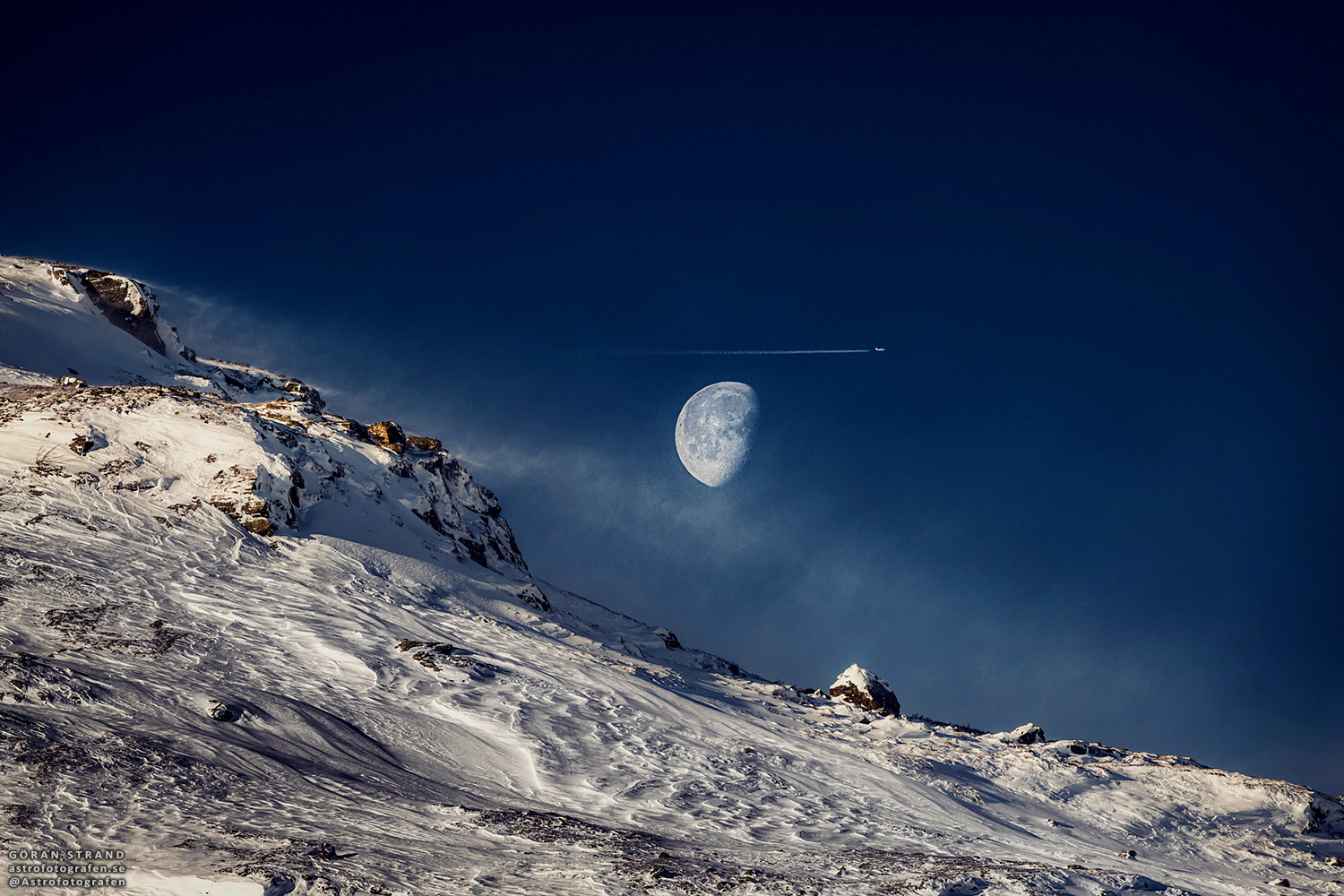
NASA PhotoNews: Gibbous Moon beyond Swedish Mountain Image Credit & Copyright: Göran Strand Explanation: This is a gibbous Moon. More Earthlings are familiar with a full moon, when the entire face of Luna is lit by the Sun, and a crescent moon, when only a sliver of the Moon's face is lit. When more than half of the Moon is illuminated, though, but still short of full illumination, the phase is called gibbous. Rarely seen in television and movies, gibbous moons are quite common in the actual night sky. The featured image was taken in Jämtland, Sweden near the end of last month. That gibbous moon turned, in a few days, into a crescent moon, and then a new moon, then back to a crescent, and a few days ago back to gibbous. And this same gibbous moon is visible again tonight, leading up to the Full Beaver Moon that occurs Friday night. Setting up to capture a picturesque gibbous moonscape, the photographer was quite surprised to find an airplane, surely well in the foregrou...

NASA PhotoNews: Astronaut Exploring: An Apollo 15 Panorama

Image
NASA PhotoNews: Astronaut Exploring: An Apollo 15 Panorama Image Credit & Copyright: NASA, USGS, Apollo 15 Crew Explanation: What would it be like to explore the Moon? NASA's Apollo missions gave humans just this chance in the late 1960s and early 1970s. In particular, the Apollo 15 mission was dedicated to better understanding the surface of the Moon by exploring mountains, valleys, maria, and highlands. Astronauts David Scott and James Irwin spent nearly three days on the Moon while Alfred Worden orbited above in the Command Module. The mission, which blasted off from Earth on 1971 July 26, was the first to deploy a Lunar Roving Vehicle. Pictured in this digitally stitched mosaic panorama, David Scott, exploring his surroundings, examines a boulder in front of the summit of Mt. Hadley Delta. The shadow of James Irwin is visible to the right, while scrolling to the right will reveal a well-lit and diverse lunar terrain. The Apollo 15 mission returned about 76 kilograms...

NASA PhotoNews: Apollo 12 Visits Surveyor 3

Image
NASA PhotoNews: Apollo 12 Visits Surveyor 3 Image Credit: Apollo 12 Crew, NASA Explanation: Apollo 12 was the second mission to land humans on the Moon. The landing site was picked to be near the location of Surveyor 3, a robot spacecraft that had landed on the Moon three years earlier. In the featured photograph, taken by lunar module pilot Alan Bean, mission commander Pete Conrad jiggles the Surveyor spacecraft to see how firmly it is situated. The lunar module is visible in the distance. Apollo 12 brought back many photographs and moon rocks. Among the milestones achieved by Apollo 12 was the deployment of the Apollo Lunar Surface Experiments Package, which carried out many experiments including one that measured the solar wind. === #NASA #space #photonews 18.10.22

NASA PhotoNews: The Falcon 9 Nebula

Image
NASA PhotoNews: The Falcon 9 Nebula Image Credit & Copyright: Brian Haidet Explanation: Not the Hubble Space Telescope's latest view of a distant planetary nebula, this illuminated cloud of gas and dust dazzled even casual U.S. west coast skygazers on October 7. Taken about three miles north of Vandenberg Air Force Base, the image follows plumes and exhaust from the first and second stage of a SpaceX Falcon 9 rocket rising through southern California's early evening skies. In the fading twilight, the reddish smoke drifting in the foreground at the right is from the initial ascent of the rocket. The expanding blue and orange filamentary plumes are from first and second stage separation and the first stage boostback burn, still in sunlight at extreme altitudes. But the bright spot below center is the second stage itself headed almost directly away from the camera, accelerating to orbital velocity and far downrange. Pulsed thrusters form the upside down V-shape at the ...

NASA PhotoNews: 55 Nights with Saturn

Image
NASA PhotoNews: 55 Nights with Saturn Image Credit & Copyright: Tunc Tezel (TWAN) Explanation: For 55 consecutive nights Mediterranean skies were at least partly clear this summer, from the 1st of July to the 24th of August 2018. An exposure from each night was incorporated in this composited telephoto and telescopic image to follow bright planet Saturn as it wandered through the generous evening skies. Through August, the outer planet's seasonal apparent retrograde motion slowed and drifted to the right, framed by a starry background. That brought it near the line-of-sight to the central Milky Way, and the beautiful Lagoon (M8) and Trifid (M20) nebulae. Of course Saturn's largest moon Titan was also along for the ride. Swinging around the gas giant in a 16 day long orbit, Titan's resulting wave-like motion is easier to spot when the almost-too-bright Saturn is digitally edited from the scene. === #NASA #space #photonews 18.09.29

NASA PhotoNews: NGC 1898: Globular Cluster in the Large Magellanic Cloud

Image
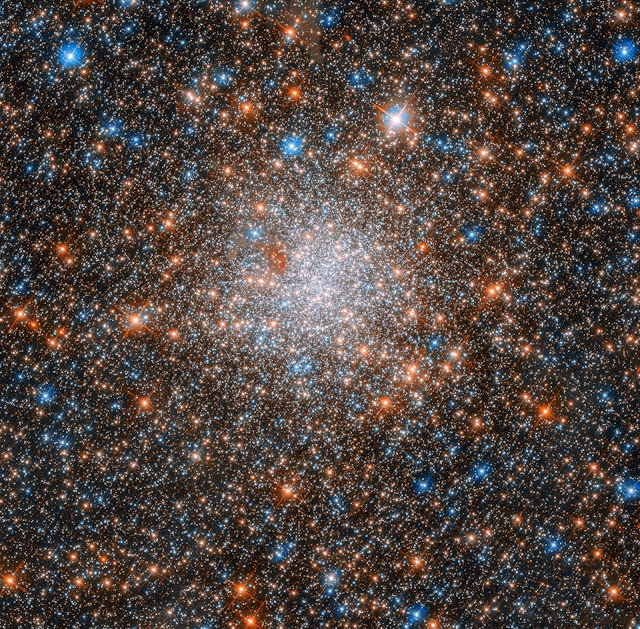
NASA PhotoNews: NGC 1898: Globular Cluster in the Large Magellanic Cloud Image Credit: ESA/Hubble & NASA Explanation: Jewels don't shine this bright -- only stars do. And almost every spot in this glittering jewel-box of an image from the Hubble Space Telescope is a star. Now some stars are more red than our Sun, and some more blue -- but all of them are much farther away. Although it takes light about 8 minutes to reach Earth from the Sun, NGC 1898 is so far away that it takes light about 160,000 years to get here. This huge ball of stars, NGC 1898, is called a globular cluster and resides in the central bar of the Large Magellanic Cloud (LMC) -- a satellite galaxy of our large Milky Way Galaxy. The featured multi-colored image includes light from the infrared to the ultraviolet and was taken to help determine if the stars of NGC 1898 all formed at the same time, or at different times. There are increasing indications that most globular clusters formed stars in stages,...

NASA PhotoNews: A Solar Filament Erupts

Image
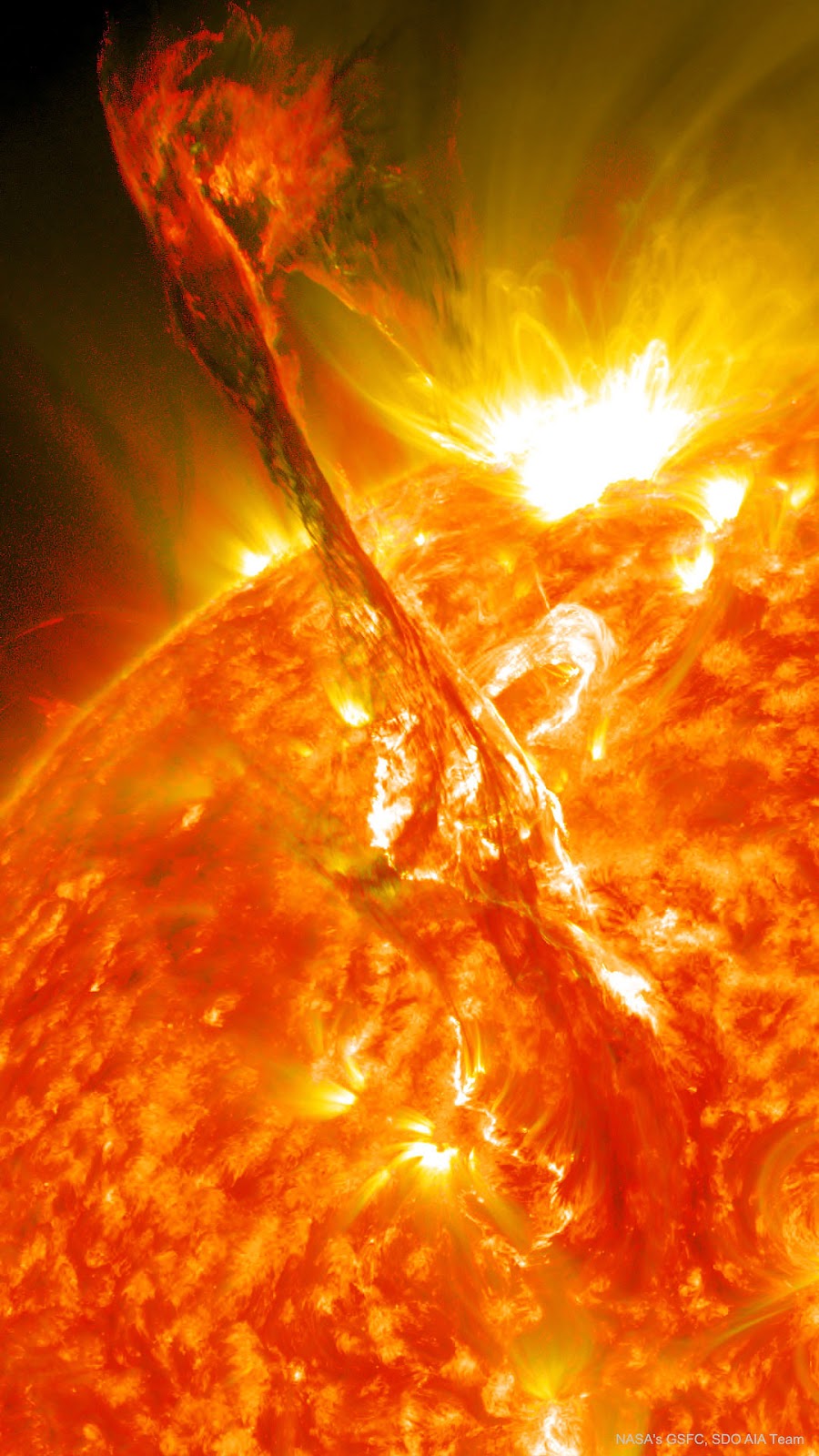
NASA PhotoNews: A Solar Filament Erupts Image Credit: NASA's GSFC, SDO AIA Team Explanation: What's happened to our Sun? Nothing very unusual -- it just threw a filament. Toward the middle of 2012, a long standing solar filament suddenly erupted into space producing an energetic Coronal Mass Ejection (CME). The filament had been held up for days by the Sun's ever changing magnetic field and the timing of the eruption was unexpected. Watched closely by the Sun-orbiting Solar Dynamics Observatory, the resulting explosion shot electrons and ions into the Solar System, some of which arrived at Earth three days later and impacted Earth's magnetosphere, causing visible aurorae. Loops of plasma surrounding an active region can be seen above the erupting filament in the featured ultraviolet image. Although the Sun is now in a relatively inactive state of its 11-year cycle, unexpected holes have opened in the Sun's corona allowing an excess of charged particles to st...

NASA PhotoNews: Mont Blanc, Meteor, and Milky Way

Image
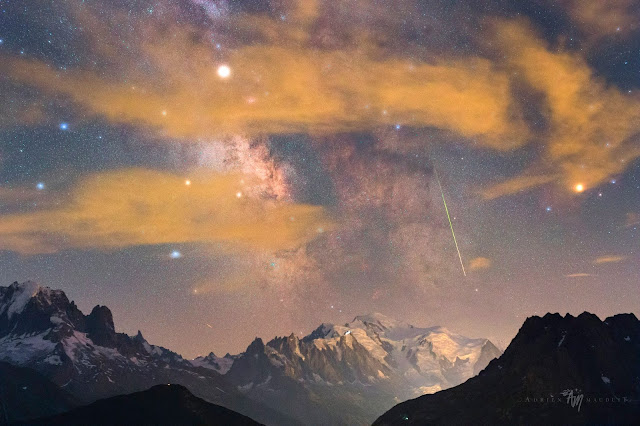
NASA PhotoNews: Mont Blanc, Meteor, and Milky Way Image Credit & Copyright: Adrien Mauduit Explanation: Snowy Mont Blanc is near the center of this atmospheric night skyscape. But high, thin clouds fogged the skies at the photographer's location, looking south toward Europe's highest peak from the southern Swiss Alps. Still, the 13 second exposure finds the faint star fields and dark rifts of the Milky Way above the famous white mountain. Bloated by the mist, bright planet Saturn and Antares (right), alpha star of Scorpius, shine through the clouds to flank the galaxy's central bulge. The high-altitude scene is from the rewarding night of August 12/13, so it also includes the green trail of a Perseid meteor shooting along the galactic plane. === #NASA #space #photonews 18.09.15

NASA PhotoNews: Ice Halos at Yellowknife

Image
NASA PhotoNews: Ice Halos at Yellowknife Image Credit & Copyright: Stephen Bedingfield Explanation: You've probably seen a circle around the Sun before. More common than rainbows, ice halos, like a 22 degree circular halo for example, can be easy to spot, especially if you can shade your eyes from direct sunlight. Still it's rare to see such a diverse range of ice halos, including sundogs, tangent, infralateral, and Parry arcs, all found in this snapshot from planet Earth. The picture was quickly taken in the late morning of September 4 from Yellowknife, Northwest Territories, Canada. The beautiful patterns are generated as sunlight (or moonlight) is reflected and refracted in six-sided water ice crystals in Earth's atmosphere. Of course, atmospheric ice halos in the skies of other worlds are likely to be different. Ice Halos at Yellowknife detailed.   === #NASA #space #photonews 18.09.14

NASA PhotoNews: Milky Way over Troll's Tongue

Image
NASA PhotoNews: Milky Way over Troll's Tongue Image Credit & Copyright: Ruslan Merzlyakov (RMS Photography) Explanation: You have to take a long hike to see the Troll's Tongue -- ten hours over rocky terrain. And in this case, it took three trips to capture the landform below a clear night sky. Trolltunga itself is a picturesque rock protrusion extending about 700 meters over mountainous cliffs near Lake Ringedalsvatnet in Norway. The overhang is made of billion-year-old Precambrian bedrock that was carved out by glaciers during an ice-age about 10,000 years ago. The featured picture is a composite of two exposures, a 15-second image of the foreground Earth followed 40 minutes later by an 87-second exposure of the background sky. Thousands of discernable stars dot the backdrop starscape in addition to billions of unresolved stars in the nearly vertical band of our Milky Way Galaxy.  === #NASA #space #photonews

M1: The Crab Nebula from Hubble

Image
M1: The Crab Nebula from Hubble Image Credit: NASA, ESA, Hubble, J. Hester, A. Loll (ASU) Explanation: This is the mess that is left when a star explodes. The Crab Nebula, the result of a supernova seen in 1054 AD, is filled with mysterious filaments. The filaments are not only tremendously complex, but appear to have less mass than expelled in the original supernova and a higher speed than expected from a free explosion. The featured image, taken by the Hubble Space Telescope, is presented in three colors chosen for scientific interest. The Crab Nebula spans about 10 light-years. In the nebula's very center lies a pulsar: a neutron star as massive as the Sun but with only the size of a small town. The Crab Pulsar rotates about 30 times each second. Original link: https://apod.nasa.gov/apod/ap180909.html === #NASA #space #photonews

Saturn's North Polar Hexagon

Image
Saturn's North Polar Hexagon Image Credit: NASA, JPL-Caltech, Space Science Institute, Hampton University Explanation: In full view, the amazing six-sided jet stream known as Saturn's north polar hexagon is shown in this colorful Cassini image. Extending to 70 degrees north latitude, the false-color video frame is map-projected, based on infrared, visible, and ultraviolet image data recorded by the Saturn-orbiting spacecraft in late 2012. First found in the outbound Voyager flyby images from the 1980s, the bizarre, long-lived feature tied to the planet's rotation is about 30,000 kilometers across. At its center lies the ringed gas giant's hurricane-like north polar storm. A new long term study of Cassini data has found a remarkable higher-altitude vortex, exactly matching the outlines of the north polar hexagon, that formed as summer approached the planet's northern hemisphere. It appears to reach hundreds of kilometers above these deeper cloud tops, into Sat...

Best NASA photonews: Aurora around Saturn's North Pole

Image
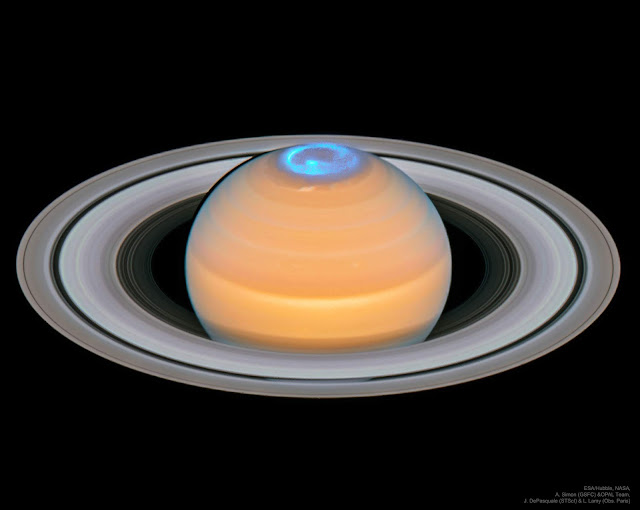
Aurora around Saturn's North Pole Image Credit: NASA, ESA, Hubble, OPAL Program, J. DePasquale (STScI), L. Lamy (Obs. Paris) Explanation: Are Saturn's auroras like Earth's? To help answer this question, the Hubble Space Telescope and the Cassini spacecraft monitored Saturn's North Pole simultaneously during Cassini's final orbits around the gas giant in September 2017. During this time, Saturn's tilt caused its North Pole to be clearly visible from Earth. The featured image is a composite of ultraviolet images of aurora and optical images of Saturn's clouds and rings, all taken recently by Hubble. Like on Earth, Saturn's northern auroras can make total or partial rings around the pole. Unlike on Earth, however, Saturn's auroras are frequently spirals -- and more likely to peak in brightness just before midnight and dawn. In contrast to Jupiter's auroras, Saturn's auroras appear better related to connecting Saturn's internal magneti...

FREE download collection "NASA - best photos". January - December, 2018

Image
FREE download collection "NASA - best photos".  January - December, 2018 Hello my dear friends!   FREE download my collection "NASA - best photos"! January - December, 2018

Sea and Sky Glows over the Oregon Coast

Image
Sea and Sky Glows over the Oregon Coast Image Credit & Copyright: Rudy Montoya Explanation: Every step caused the sand to light up blue. That glow was bioluminescence -- a blue radiance that also lights the surf in this surreal scene captured last month at Meyer's Creek Beach in Oregon, USA. Volcanic stacks dot the foreground sea, while a thin fog layer scatters light on the horizon. The rays of light spreading from the left horizon were created by car headlights on the Oregon Coast Highway (US 101), while the orange light on the right horizon emanates from a fishing boat. Visible far in the distance is the band of our Milky Way Galaxy, appearing to rise from a dark rocky outcrop. Sixteen images were added together to bring up the background Milky Way and to reduce noise.  Original link: https://apod.nasa.gov/apod/ap180828.html === #NASA #space #photonews

Seeing Titan

Image
Seeing Titan Image Credit: VIMS Team, U. Arizona, U. Nantes, ESA, NASA Explanation: Shrouded in a thick atmosphere, Saturn's largest moon Titan really is hard to see. Small particles suspended in the upper atmosphere cause an almost impenetrable haze, strongly scattering light at visible wavelengths and hiding Titan's surface features from prying eyes. But Titan's surface is better imaged at infrared wavelengths where scattering is weaker and atmospheric absorption is reduced. Arrayed around this centered visible light image of Titan are some of the clearest global infrared views of the tantalizing moon so far. In false color, the six panels present a consistent processing of 13 years of infrared image data from the Visual and Infrared Mapping Spectrometer (VIMS) on board the Cassini spacecraft. They offer a stunning comparison with Cassini's visible light view. Original link: https://apod.nasa.gov/apod/ap180818.html === #NASA #space #photonews

Parker vs Perseid

Image
Parker vs Perseid Image Credit & Copyright: Derek Demeter (Emil Buehler Planetarium) Explanation: The brief flash of a bright Perseid meteor streaks across the upper right in this composited series of exposures made early Sunday morning near the peak of the annual Perseid meteor shower. Set up about two miles from Space Launch Complex 37 at Cape Canaveral Air Force Station, the photographer also captured the four minute long trail of a Delta IV Heavy rocket carrying the Parker Solar Probe into the dark morning sky. Perseid meteors aren't slow. The grains of dust from periodic comet Swift-Tuttle vaporize as they plow through Earth's upper atmosphere at about 60 kilometers per second (133,000 mph). On its way to seven gravity-assist flybys of Venus over its seven year mission, the Parker Solar Probe's closest approach to the Sun will steadily decrease, finally reaching a distance of 6.1 million kilometers (3.8 million miles). That's about 1/8 the distance betw...

Launch of the Parker Solar Probe

Image
Launch of the Parker Solar Probe Image Credit & Copyright: John Kraus Explanation: When is the best time to launch a probe to the Sun? The now historic answer -- which is not a joke because this really happened this past weekend -- was at night. Night, not only because NASA's Parker Solar Probe's (PSP) launch window to its planned orbit occurred, in part, at night, but also because most PSP instruments will operate in the shadow of its shield -- in effect creating its own perpetual night near the Sun. Before then, years will pass as the PSP sheds enough orbital energy to approach the Sun, swinging past Venus seven times. Eventually, the PSP is scheduled to pass dangerously close to the Sun, within 9 solar radii, the closest ever. This close, the temperature will be 1,400 degrees Celsius on the day side of the PSP's Sun shield -- hot enough to melt many forms of glass. On the night side, though, it will be near room temperature. A major goal of the PSP's miss...