Posts

Showing posts with the label Moon

FREE download collection "NASA - best photos". January - June, 2019.

Image
FREE download collection "NASA - best photos". January - June, 2019. Hello everyone! FREE download my collection "NASA - best photos"! January - June, 2019 1 ZIP file 1.20 Gb Free download link: https://drive.google.com/open?id=1NwHSrNDAZ4I52BWIa6s7lHGY11WGn1m7   Our YouTube channel: https://www.youtube.com/watch?v=l8yqBrxUj8Y === #NASA #space #photonews

NASA PhotoNews: Earthrise 1: Historic Image Remastered

Image
NASA PhotoNews: Earthrise 1: Historic Image Remastered Image Credit: NASA, Apollo 8 Crew, Bill Anders; Processing and License: Jim Weigang Explanation: "Oh my God! Look at that picture over there! Here's the Earth coming up. Wow is that pretty!" Soon after that pronouncement, 50 years ago today, one of the most famous images ever taken was snapped from the orbit of the Moon. Now known as "Earthrise", the iconic image shows the Earth rising above the limb of the Moon, as taken by the crew of Apollo 8. But the well-known Earthrise image was actually the second image taken of the Earth rising above the lunar limb -- it was just the first in color. With modern digital technology, however, the real first Earthrise image -- originally in black and white -- has now been remastered to have the combined resolution and color of the first three images. Behold! The featured image is a close-up of the picture that Apollo 8 astronaut Bill Anders was talking about. Tha...

NASA PhotoNews: Phobos: Doomed Moon of Mars

Image
NASA PhotoNews: Phobos: Doomed Moon of Mars Image Credit: Viking Project, JPL, NASA; Mosaic Processing: Edwin V. Bell II (NSSDC/Raytheon ITSS) Explanation: This moon is doomed. Mars, the red planet named for the Roman god of war, has two tiny moons, Phobos and Deimos, whose names are derived from the Greek for Fear and Panic. The origin of the Martian moons is unknown, though, with a leading hypothesis holding that they are captured asteroids. The larger moon, at 25-kilometers across, is Phobos, and is indeed seen to be a cratered, asteroid-like object in this false-colored image mosaic taken by the robotic Viking 1 mission in 1978. A recent analysis of the unusual long grooves seen on Phobos indicates that they may result from boulders rolling away from the giant impact that created the crater on the upper left: Stickney Crater. Phobos orbits so close to Mars - about 5,800 kilometers above the surface compared to 400,000 kilometers for our Moon - that gravitational tidal force...

Shipwreck at Moonset

Image
Shipwreck at Moonset Image Credit & Copyright: Vikas Chander Explanation: A crescent Moon is about to sink under the western horizon in this sea and night skyscape. The atmospheric photo was taken on September 11 from the desert shore along the Skeleton Coast of Namibia. So close to moonset, the moonlight is reddened and dimmed by the low, long line-of-sight across the Atlantic. But near the center of the frame Venus still shines brightly, its light reflected in calm ocean waters. The celestial beacon above the brilliant evening star is bright planet Jupiter. Namibia's Skeleton Coast was so named for the many seal and whale bones that were once strewn along the shoreline. In more recent times it's better known for shipwrecks. === #NASA #space #photonews 18.11.24

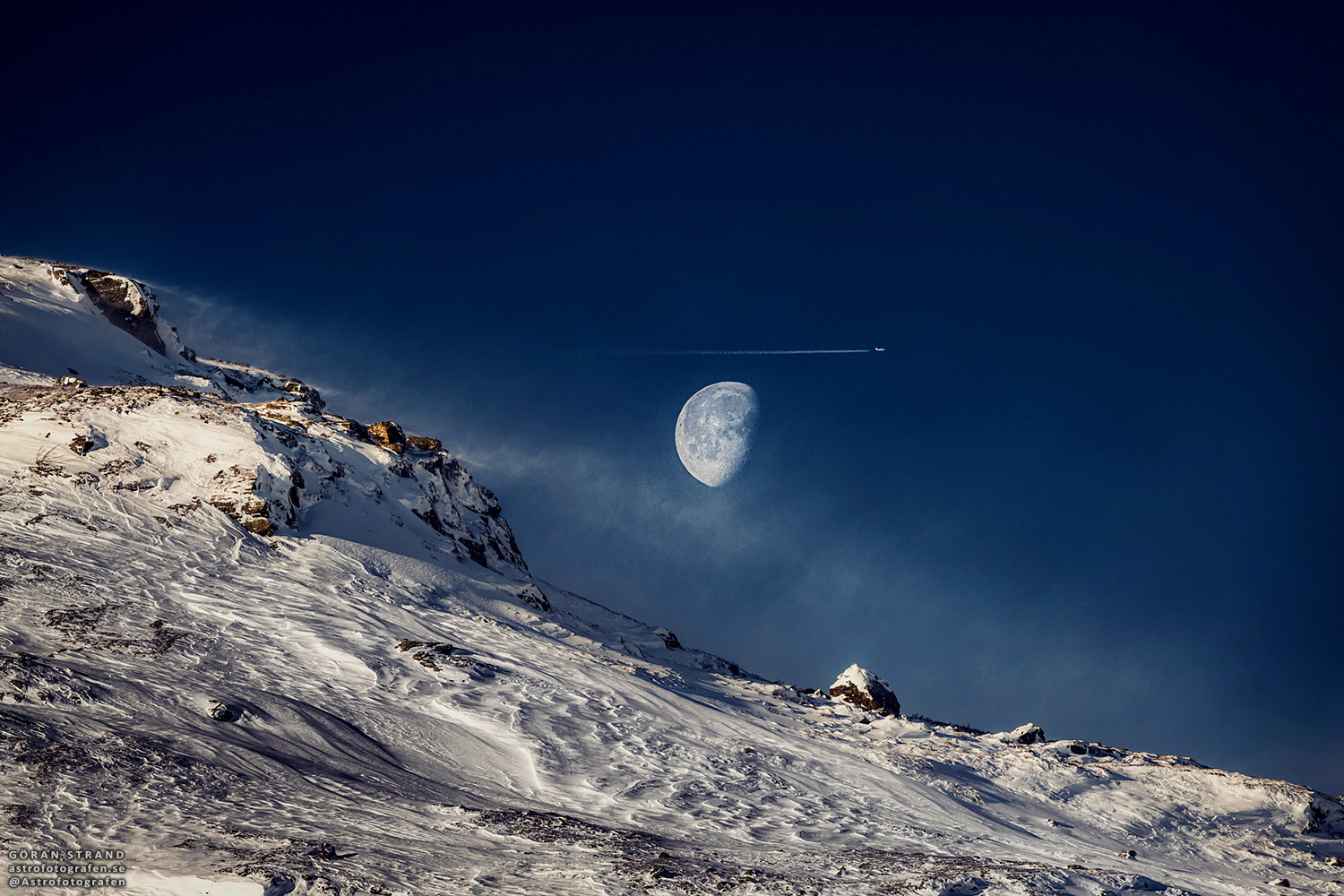
NASA PhotoNews: Gibbous Moon beyond Swedish Mountain

Image
NASA PhotoNews: Gibbous Moon beyond Swedish Mountain Image Credit & Copyright: Göran Strand Explanation: This is a gibbous Moon. More Earthlings are familiar with a full moon, when the entire face of Luna is lit by the Sun, and a crescent moon, when only a sliver of the Moon's face is lit. When more than half of the Moon is illuminated, though, but still short of full illumination, the phase is called gibbous. Rarely seen in television and movies, gibbous moons are quite common in the actual night sky. The featured image was taken in Jämtland, Sweden near the end of last month. That gibbous moon turned, in a few days, into a crescent moon, and then a new moon, then back to a crescent, and a few days ago back to gibbous. And this same gibbous moon is visible again tonight, leading up to the Full Beaver Moon that occurs Friday night. Setting up to capture a picturesque gibbous moonscape, the photographer was quite surprised to find an airplane, surely well in the foregrou...

NASA PhotoNews: Astronaut Exploring: An Apollo 15 Panorama

Image
NASA PhotoNews: Astronaut Exploring: An Apollo 15 Panorama Image Credit & Copyright: NASA, USGS, Apollo 15 Crew Explanation: What would it be like to explore the Moon? NASA's Apollo missions gave humans just this chance in the late 1960s and early 1970s. In particular, the Apollo 15 mission was dedicated to better understanding the surface of the Moon by exploring mountains, valleys, maria, and highlands. Astronauts David Scott and James Irwin spent nearly three days on the Moon while Alfred Worden orbited above in the Command Module. The mission, which blasted off from Earth on 1971 July 26, was the first to deploy a Lunar Roving Vehicle. Pictured in this digitally stitched mosaic panorama, David Scott, exploring his surroundings, examines a boulder in front of the summit of Mt. Hadley Delta. The shadow of James Irwin is visible to the right, while scrolling to the right will reveal a well-lit and diverse lunar terrain. The Apollo 15 mission returned about 76 kilograms...

NASA PhotoNews: Apollo 12 Visits Surveyor 3

Image
NASA PhotoNews: Apollo 12 Visits Surveyor 3 Image Credit: Apollo 12 Crew, NASA Explanation: Apollo 12 was the second mission to land humans on the Moon. The landing site was picked to be near the location of Surveyor 3, a robot spacecraft that had landed on the Moon three years earlier. In the featured photograph, taken by lunar module pilot Alan Bean, mission commander Pete Conrad jiggles the Surveyor spacecraft to see how firmly it is situated. The lunar module is visible in the distance. Apollo 12 brought back many photographs and moon rocks. Among the milestones achieved by Apollo 12 was the deployment of the Apollo Lunar Surface Experiments Package, which carried out many experiments including one that measured the solar wind. === #NASA #space #photonews 18.10.22