Posts

Showing posts with the label planet

FREE download collection "NASA - best photos". January - June, 2019.

Image
FREE download collection "NASA - best photos". January - June, 2019. Hello everyone! FREE download my collection "NASA - best photos"! January - June, 2019 1 ZIP file 1.20 Gb Free download link: https://drive.google.com/open?id=1NwHSrNDAZ4I52BWIa6s7lHGY11WGn1m7   Our YouTube channel: https://www.youtube.com/watch?v=l8yqBrxUj8Y === #NASA #space #photonews

NASA PhotoNews: Earthrise 1: Historic Image Remastered

Image
NASA PhotoNews: Earthrise 1: Historic Image Remastered Image Credit: NASA, Apollo 8 Crew, Bill Anders; Processing and License: Jim Weigang Explanation: "Oh my God! Look at that picture over there! Here's the Earth coming up. Wow is that pretty!" Soon after that pronouncement, 50 years ago today, one of the most famous images ever taken was snapped from the orbit of the Moon. Now known as "Earthrise", the iconic image shows the Earth rising above the limb of the Moon, as taken by the crew of Apollo 8. But the well-known Earthrise image was actually the second image taken of the Earth rising above the lunar limb -- it was just the first in color. With modern digital technology, however, the real first Earthrise image -- originally in black and white -- has now been remastered to have the combined resolution and color of the first three images. Behold! The featured image is a close-up of the picture that Apollo 8 astronaut Bill Anders was talking about. Tha...

NASA PhotoNews: Swimming on Jupiter

Image
NASA PhotoNews: Swimming on Jupiter Image Credit: NASA, JPL-Caltech, SwRI, MSSS; Processing & License: Brian Swift, Sean Doran Explanation: On October 29, the Juno spacecraft once again dove near the turbulent Jovian cloud tops. Its 16th orbital closest approach or perijove passage, brought Juno within 3,500 kilometers of the Solar System's largest planetary atmosphere. These frames, recorded by JunoCam while the spacecraft cruised 20 - 50 thousand kilometers above the planet's middle southern latitudes, seem to follow a swirling cloud shaped remarkably like a dolphin. Swimming along Jupiter's darker South South Temperate Belt, this dolphin is itself planet-sized though, some thousands of kilometers across. Junos next passage was on December 21, 2018. === #NASA #space #photonews 18.12.14

NASA PhotoNews: Sound and Light Captured by Mars InSight

Image
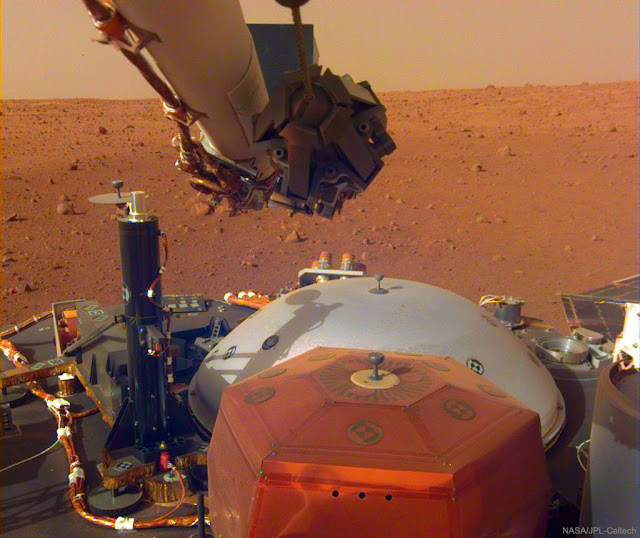
NASA PhotoNews: Sound and Light Captured by Mars InSight Image Credit: NASA/JPL-Caltech Explanation: Your arm on Mars has unusual powers. For one thing it is nearly 2 meters long, has a scoop and grapple built into its hand, and has a camera built into its forearm. For another, it will soon deploy your ear -- a sensitive seismometer that will listen for distant rumblings -- onto the surface of Mars. Your SEISmomet-ear is the orange box in the foreground, while the gray dome behind it will be its protective cover. Your arm is attached to the InSight robotic lander that touched down on Mars two weeks ago. Somewhat unexpectedly, your ear has already heard something -- slight vibrations caused by the Martian wind flowing over the solar panels. Light from the Sun is being collected by the solar panels, part of one being visible on the far right. Actually, at the present time, you have two arms operating on Mars, but they are separated by about 600 kilometers. That's because you...

NASA PhotoNews: Phobos: Doomed Moon of Mars

Image
NASA PhotoNews: Phobos: Doomed Moon of Mars Image Credit: Viking Project, JPL, NASA; Mosaic Processing: Edwin V. Bell II (NSSDC/Raytheon ITSS) Explanation: This moon is doomed. Mars, the red planet named for the Roman god of war, has two tiny moons, Phobos and Deimos, whose names are derived from the Greek for Fear and Panic. The origin of the Martian moons is unknown, though, with a leading hypothesis holding that they are captured asteroids. The larger moon, at 25-kilometers across, is Phobos, and is indeed seen to be a cratered, asteroid-like object in this false-colored image mosaic taken by the robotic Viking 1 mission in 1978. A recent analysis of the unusual long grooves seen on Phobos indicates that they may result from boulders rolling away from the giant impact that created the crater on the upper left: Stickney Crater. Phobos orbits so close to Mars - about 5,800 kilometers above the surface compared to 400,000 kilometers for our Moon - that gravitational tidal force...

Shipwreck at Moonset

Image
Shipwreck at Moonset Image Credit & Copyright: Vikas Chander Explanation: A crescent Moon is about to sink under the western horizon in this sea and night skyscape. The atmospheric photo was taken on September 11 from the desert shore along the Skeleton Coast of Namibia. So close to moonset, the moonlight is reddened and dimmed by the low, long line-of-sight across the Atlantic. But near the center of the frame Venus still shines brightly, its light reflected in calm ocean waters. The celestial beacon above the brilliant evening star is bright planet Jupiter. Namibia's Skeleton Coast was so named for the many seal and whale bones that were once strewn along the shoreline. In more recent times it's better known for shipwrecks. === #NASA #space #photonews 18.11.24

NASA PhotoNews: Swirls and Colors on Jupiter from Juno

Image
NASA PhotoNews:  Swirls and Colors on Jupiter from Juno Image Credit: NASA, Juno, SwRI, MSSS; Processing & License: Matt Brealey, Seán Doran Explanation: What creates the colors in Jupiter's clouds? No one is sure. The thick atmosphere of Jupiter is mostly hydrogen and helium, elements which are colorless at the low temperatures of the Jovian cloud tops. Which trace elements provide the colors remains a topic of research, although small amounts of ammonium hydrosulfide are one leading candidate. What is clear from the featured color-enhanced image -- and many similar images -- is that lighter clouds are typically higher up than darker ones. Pictured, light clouds swirl around reddish regions toward the lower right, while they appear to cover over some darker domains on the upper right. The featured image was taken by the robotic Juno spacecraft during its 14th low pass over Jupiter earlier this year. Juno continues in its looping elliptical orbit, swooping near the huge ...

NASA PhotoNews: Gibbous Moon beyond Swedish Mountain

Image
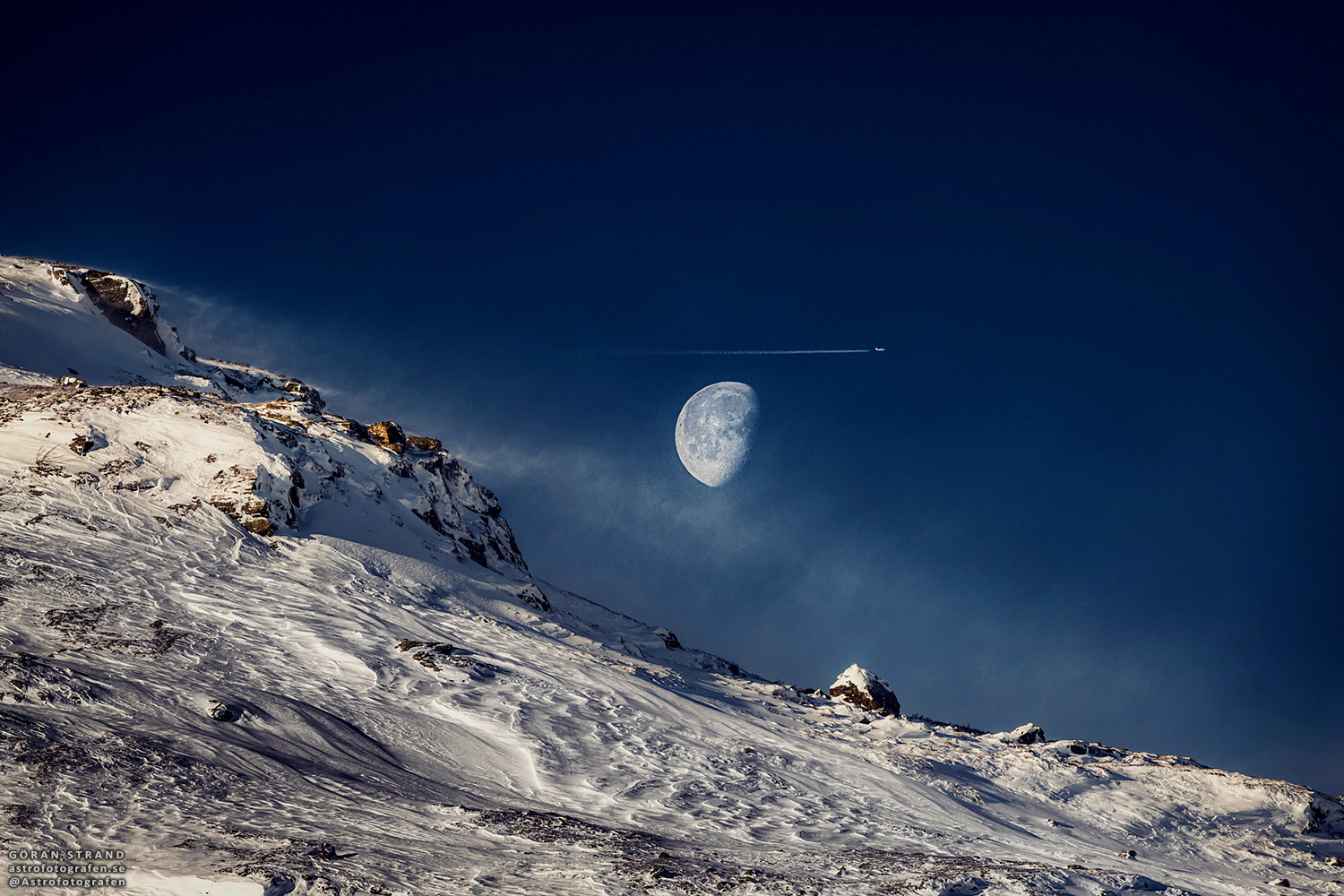
NASA PhotoNews: Gibbous Moon beyond Swedish Mountain Image Credit & Copyright: Göran Strand Explanation: This is a gibbous Moon. More Earthlings are familiar with a full moon, when the entire face of Luna is lit by the Sun, and a crescent moon, when only a sliver of the Moon's face is lit. When more than half of the Moon is illuminated, though, but still short of full illumination, the phase is called gibbous. Rarely seen in television and movies, gibbous moons are quite common in the actual night sky. The featured image was taken in Jämtland, Sweden near the end of last month. That gibbous moon turned, in a few days, into a crescent moon, and then a new moon, then back to a crescent, and a few days ago back to gibbous. And this same gibbous moon is visible again tonight, leading up to the Full Beaver Moon that occurs Friday night. Setting up to capture a picturesque gibbous moonscape, the photographer was quite surprised to find an airplane, surely well in the foregrou...

NASA PhotoNews: Astronaut Exploring: An Apollo 15 Panorama

Image
NASA PhotoNews: Astronaut Exploring: An Apollo 15 Panorama Image Credit & Copyright: NASA, USGS, Apollo 15 Crew Explanation: What would it be like to explore the Moon? NASA's Apollo missions gave humans just this chance in the late 1960s and early 1970s. In particular, the Apollo 15 mission was dedicated to better understanding the surface of the Moon by exploring mountains, valleys, maria, and highlands. Astronauts David Scott and James Irwin spent nearly three days on the Moon while Alfred Worden orbited above in the Command Module. The mission, which blasted off from Earth on 1971 July 26, was the first to deploy a Lunar Roving Vehicle. Pictured in this digitally stitched mosaic panorama, David Scott, exploring his surroundings, examines a boulder in front of the summit of Mt. Hadley Delta. The shadow of James Irwin is visible to the right, while scrolling to the right will reveal a well-lit and diverse lunar terrain. The Apollo 15 mission returned about 76 kilograms...

NASA PhotoNews: Apollo 12 Visits Surveyor 3

Image
NASA PhotoNews: Apollo 12 Visits Surveyor 3 Image Credit: Apollo 12 Crew, NASA Explanation: Apollo 12 was the second mission to land humans on the Moon. The landing site was picked to be near the location of Surveyor 3, a robot spacecraft that had landed on the Moon three years earlier. In the featured photograph, taken by lunar module pilot Alan Bean, mission commander Pete Conrad jiggles the Surveyor spacecraft to see how firmly it is situated. The lunar module is visible in the distance. Apollo 12 brought back many photographs and moon rocks. Among the milestones achieved by Apollo 12 was the deployment of the Apollo Lunar Surface Experiments Package, which carried out many experiments including one that measured the solar wind. === #NASA #space #photonews 18.10.22

NASA PhotoNews: Jupiter in Ultraviolet from Hubble

Image
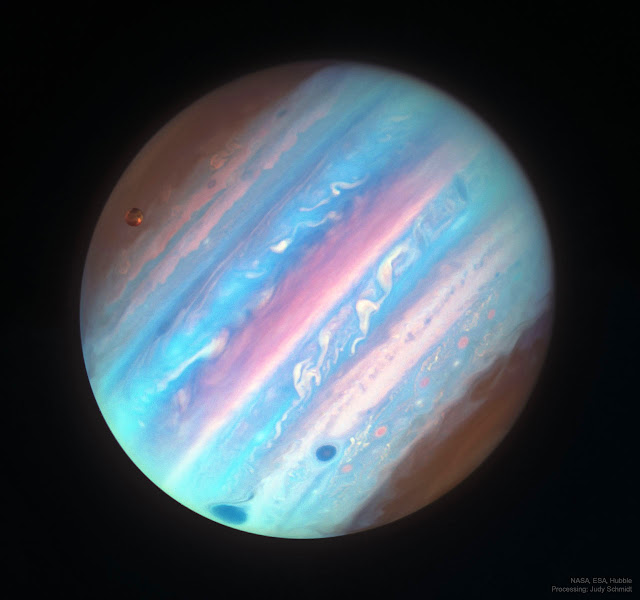
NASA PhotoNews:  Jupiter in Ultraviolet from Hubble Image Credit: NASA, ESA, Hubble; Processing & License: Judy Schmidt Explanation: Jupiter looks a bit different in ultraviolet light. To better interpret Jupiter's cloud motions and to help NASA's robotic Juno spacecraft understand the planetary context of the small fields that it sees, the Hubble Space Telescope is being directed to regularly image the entire Jovian giant. The colors of Jupiter being monitored go beyond the normal human visual range to include both ultraviolet and (not pictured) infrared light. Featured from 2017, Jupiter appears different in near ultraviolet light, partly because the amount of sunlight reflected back is distinct, giving differing cloud heights and latitudes discrepant brightnesses. In the near UV, Jupiter's poles appear relatively dark, as does its Great Red Spot and a smaller (optically) white oval to the right. The String of Pearl storms farther to the right, however, are br...

NASA PhotoNews: The Falcon 9 Nebula

Image
NASA PhotoNews: The Falcon 9 Nebula Image Credit & Copyright: Brian Haidet Explanation: Not the Hubble Space Telescope's latest view of a distant planetary nebula, this illuminated cloud of gas and dust dazzled even casual U.S. west coast skygazers on October 7. Taken about three miles north of Vandenberg Air Force Base, the image follows plumes and exhaust from the first and second stage of a SpaceX Falcon 9 rocket rising through southern California's early evening skies. In the fading twilight, the reddish smoke drifting in the foreground at the right is from the initial ascent of the rocket. The expanding blue and orange filamentary plumes are from first and second stage separation and the first stage boostback burn, still in sunlight at extreme altitudes. But the bright spot below center is the second stage itself headed almost directly away from the camera, accelerating to orbital velocity and far downrange. Pulsed thrusters form the upside down V-shape at the ...

NASA PhotoNews: 55 Nights with Saturn

Image
NASA PhotoNews: 55 Nights with Saturn Image Credit & Copyright: Tunc Tezel (TWAN) Explanation: For 55 consecutive nights Mediterranean skies were at least partly clear this summer, from the 1st of July to the 24th of August 2018. An exposure from each night was incorporated in this composited telephoto and telescopic image to follow bright planet Saturn as it wandered through the generous evening skies. Through August, the outer planet's seasonal apparent retrograde motion slowed and drifted to the right, framed by a starry background. That brought it near the line-of-sight to the central Milky Way, and the beautiful Lagoon (M8) and Trifid (M20) nebulae. Of course Saturn's largest moon Titan was also along for the ride. Swinging around the gas giant in a 16 day long orbit, Titan's resulting wave-like motion is easier to spot when the almost-too-bright Saturn is digitally edited from the scene. === #NASA #space #photonews 18.09.29

NASA PhotoNews: Alvin Drew Works on the International Space Station

Image
NASA PhotoNews: Alvin Drew Works on the International Space Station Image Credit & Copyright: NASA Explanation: NASA astronaut Alvin Drew participated in the STS-133 mission's first spacewalk as construction and maintenance continued on the International Space Station in 2011. During the six-hour, 34-minute spacewalk, Drew and fellow astronaut Steve Bowen (out of frame) installed the J612 power extension cable, move a failed ammonia pump module to the External Stowage Platform 2 on the Quest Airlock for return to Earth at a later date, installed a camera wedge on the right hand truss segment, installed extensions to the mobile transporter rail and exposed the Japanese "Message in a Bottle" experiment to space.   === #NASA #space #photonews 19.03.19

NASA PhotoNews: A Solar Filament Erupts

Image
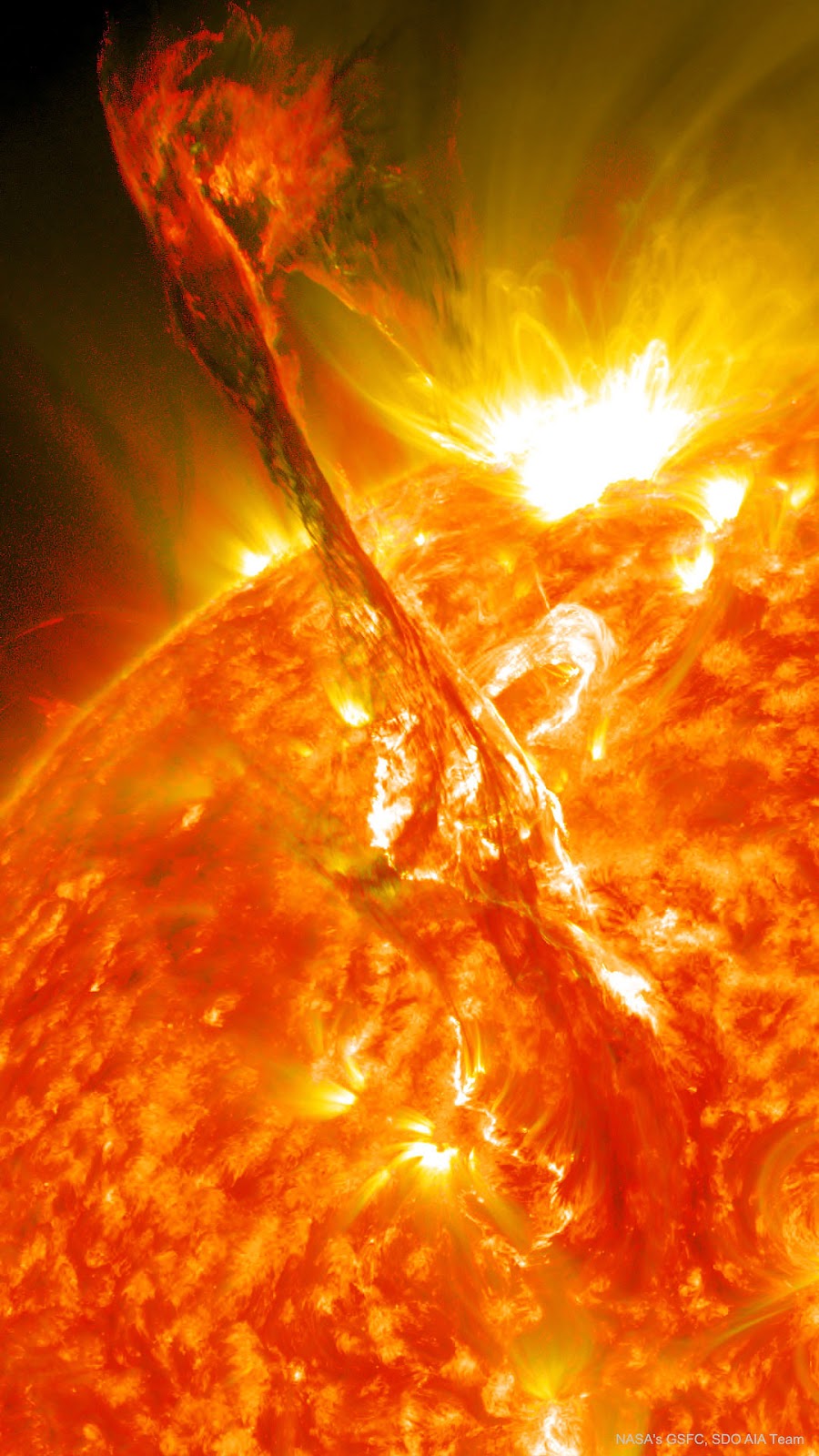
NASA PhotoNews: A Solar Filament Erupts Image Credit: NASA's GSFC, SDO AIA Team Explanation: What's happened to our Sun? Nothing very unusual -- it just threw a filament. Toward the middle of 2012, a long standing solar filament suddenly erupted into space producing an energetic Coronal Mass Ejection (CME). The filament had been held up for days by the Sun's ever changing magnetic field and the timing of the eruption was unexpected. Watched closely by the Sun-orbiting Solar Dynamics Observatory, the resulting explosion shot electrons and ions into the Solar System, some of which arrived at Earth three days later and impacted Earth's magnetosphere, causing visible aurorae. Loops of plasma surrounding an active region can be seen above the erupting filament in the featured ultraviolet image. Although the Sun is now in a relatively inactive state of its 11-year cycle, unexpected holes have opened in the Sun's corona allowing an excess of charged particles to st...

NASA PhotoNews: Milky Way over Troll's Tongue

Image
NASA PhotoNews: Milky Way over Troll's Tongue Image Credit & Copyright: Ruslan Merzlyakov (RMS Photography) Explanation: You have to take a long hike to see the Troll's Tongue -- ten hours over rocky terrain. And in this case, it took three trips to capture the landform below a clear night sky. Trolltunga itself is a picturesque rock protrusion extending about 700 meters over mountainous cliffs near Lake Ringedalsvatnet in Norway. The overhang is made of billion-year-old Precambrian bedrock that was carved out by glaciers during an ice-age about 10,000 years ago. The featured picture is a composite of two exposures, a 15-second image of the foreground Earth followed 40 minutes later by an 87-second exposure of the background sky. Thousands of discernable stars dot the backdrop starscape in addition to billions of unresolved stars in the nearly vertical band of our Milky Way Galaxy.  === #NASA #space #photonews

Saturn's North Polar Hexagon

Image
Saturn's North Polar Hexagon Image Credit: NASA, JPL-Caltech, Space Science Institute, Hampton University Explanation: In full view, the amazing six-sided jet stream known as Saturn's north polar hexagon is shown in this colorful Cassini image. Extending to 70 degrees north latitude, the false-color video frame is map-projected, based on infrared, visible, and ultraviolet image data recorded by the Saturn-orbiting spacecraft in late 2012. First found in the outbound Voyager flyby images from the 1980s, the bizarre, long-lived feature tied to the planet's rotation is about 30,000 kilometers across. At its center lies the ringed gas giant's hurricane-like north polar storm. A new long term study of Cassini data has found a remarkable higher-altitude vortex, exactly matching the outlines of the north polar hexagon, that formed as summer approached the planet's northern hemisphere. It appears to reach hundreds of kilometers above these deeper cloud tops, into Sat...

Best NASA photonews: Aurora around Saturn's North Pole

Image
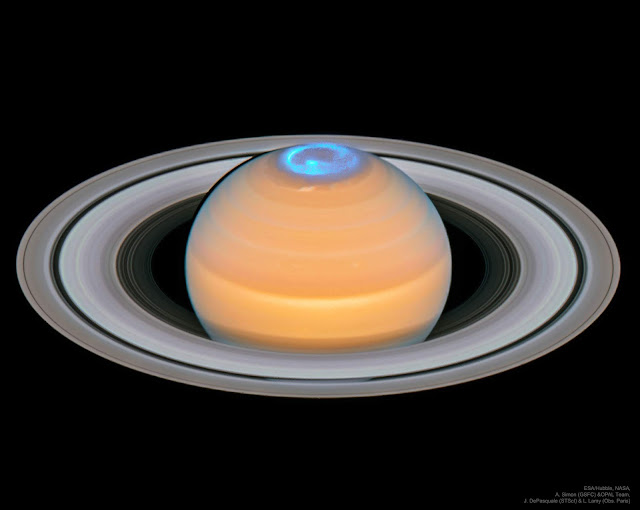
Aurora around Saturn's North Pole Image Credit: NASA, ESA, Hubble, OPAL Program, J. DePasquale (STScI), L. Lamy (Obs. Paris) Explanation: Are Saturn's auroras like Earth's? To help answer this question, the Hubble Space Telescope and the Cassini spacecraft monitored Saturn's North Pole simultaneously during Cassini's final orbits around the gas giant in September 2017. During this time, Saturn's tilt caused its North Pole to be clearly visible from Earth. The featured image is a composite of ultraviolet images of aurora and optical images of Saturn's clouds and rings, all taken recently by Hubble. Like on Earth, Saturn's northern auroras can make total or partial rings around the pole. Unlike on Earth, however, Saturn's auroras are frequently spirals -- and more likely to peak in brightness just before midnight and dawn. In contrast to Jupiter's auroras, Saturn's auroras appear better related to connecting Saturn's internal magneti...

Close Mars

Image
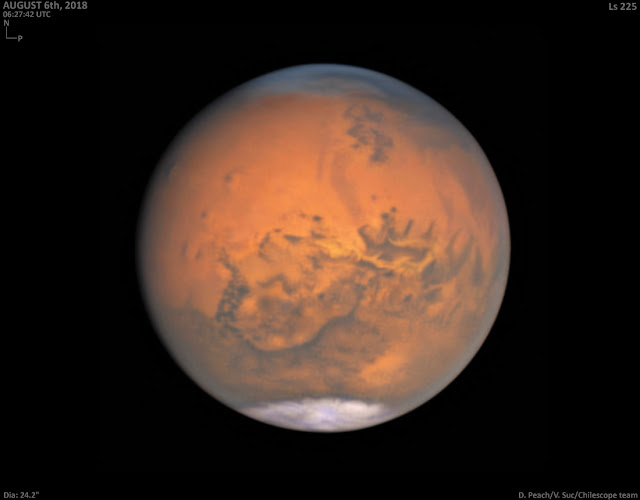
Close Mars Image Credit & Copyright: D. Peach, V. Suc, Chilescope team Explanation: Still bright in evening skies, Mars was just past opposition and closest to Earth on July 31, a mere 57.6 million kilometers away. Captured only a week later, this remarkable image shows the Red Planet's disk near its maximum size in earthbound telescopes, but still less than 1/74th the apparent diameter of a Full Moon. Broad regional surface shadings are starting to reappear in the tantalizing view as the latest planet-wide dust storm subsides. With the bright south polar cap at the bottom, the Valles Marineris extends along the center of the disk. Just below it lies the roughly circular Solis Lacus region sometimes known as the Eye of Mars. In a line, three prominent dark spots left of center are the volcanic Tharsis Montes. Original link: https://apod.nasa.gov/apod/ap180831.html === #NASA #space #photonews

FREE download collection "NASA - best photos". January - December, 2018

Image
FREE download collection "NASA - best photos".  January - December, 2018 Hello my dear friends!   FREE download my collection "NASA - best photos"! January - December, 2018