Posts

Showing posts with the label Mars

FREE download collection "NASA - best photos". January - June, 2019.

Image
FREE download collection "NASA - best photos". January - June, 2019. Hello everyone! FREE download my collection "NASA - best photos"! January - June, 2019 1 ZIP file 1.20 Gb Free download link: https://drive.google.com/open?id=1NwHSrNDAZ4I52BWIa6s7lHGY11WGn1m7   Our YouTube channel: https://www.youtube.com/watch?v=l8yqBrxUj8Y === #NASA #space #photonews

NASA PhotoNews: Sound and Light Captured by Mars InSight

Image
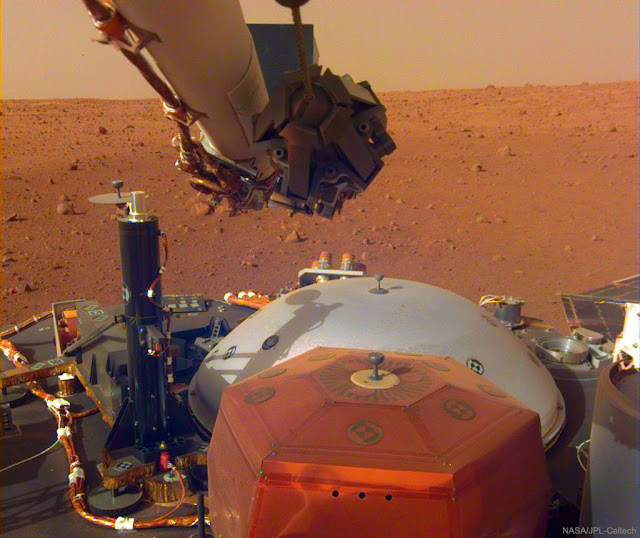
NASA PhotoNews: Sound and Light Captured by Mars InSight Image Credit: NASA/JPL-Caltech Explanation: Your arm on Mars has unusual powers. For one thing it is nearly 2 meters long, has a scoop and grapple built into its hand, and has a camera built into its forearm. For another, it will soon deploy your ear -- a sensitive seismometer that will listen for distant rumblings -- onto the surface of Mars. Your SEISmomet-ear is the orange box in the foreground, while the gray dome behind it will be its protective cover. Your arm is attached to the InSight robotic lander that touched down on Mars two weeks ago. Somewhat unexpectedly, your ear has already heard something -- slight vibrations caused by the Martian wind flowing over the solar panels. Light from the Sun is being collected by the solar panels, part of one being visible on the far right. Actually, at the present time, you have two arms operating on Mars, but they are separated by about 600 kilometers. That's because you...

NASA PhotoNews: Phobos: Doomed Moon of Mars

Image
NASA PhotoNews: Phobos: Doomed Moon of Mars Image Credit: Viking Project, JPL, NASA; Mosaic Processing: Edwin V. Bell II (NSSDC/Raytheon ITSS) Explanation: This moon is doomed. Mars, the red planet named for the Roman god of war, has two tiny moons, Phobos and Deimos, whose names are derived from the Greek for Fear and Panic. The origin of the Martian moons is unknown, though, with a leading hypothesis holding that they are captured asteroids. The larger moon, at 25-kilometers across, is Phobos, and is indeed seen to be a cratered, asteroid-like object in this false-colored image mosaic taken by the robotic Viking 1 mission in 1978. A recent analysis of the unusual long grooves seen on Phobos indicates that they may result from boulders rolling away from the giant impact that created the crater on the upper left: Stickney Crater. Phobos orbits so close to Mars - about 5,800 kilometers above the surface compared to 400,000 kilometers for our Moon - that gravitational tidal force...

NASA PhotoNews: The Lonely Neutron Star in Supernova Remnant E0102-72.3

Image
NASA PhotoNews: The Lonely Neutron Star in Supernova Remnant E0102-72.3 Credit: X-ray (NASA/CXC/ESO/F. Vogt et al.); Optical (ESO/VLT/MUSE & NASA/STScI) Explanation: Why is this neutron star off-center? Recently a lone neutron star has been found within the debris left over from an old supernova explosion. The "lonely neutron star" in question is the blue dot at the center of the red nebula near the bottom left of E0102-72.3. In the featured image composite, blue represents X-ray light captured by NASA's Chandra Observatory, while red and green represent optical light captured by ESO's Very Large Telescope in Chile and NASA's Hubble Space Telescope in orbit. The displaced position of this neutron star is unexpected since the dense star is thought to be the core of the star that exploded in the supernova and created the outer nebula. It could be that the neutron star in E0102 was pushed away from the nebula's center by the supernova itself, but then ...

Close Mars

Image
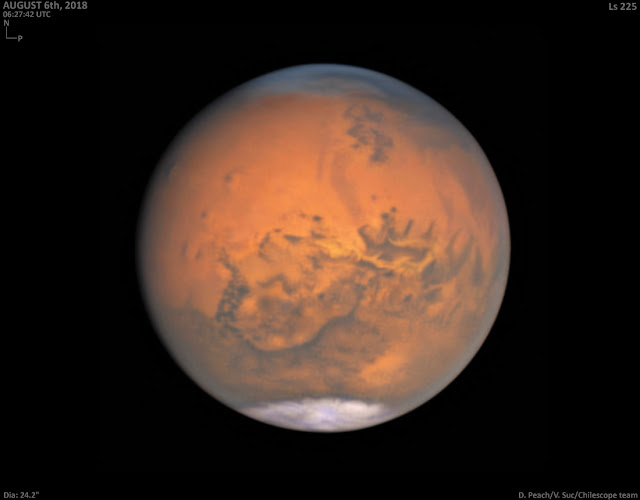
Close Mars Image Credit & Copyright: D. Peach, V. Suc, Chilescope team Explanation: Still bright in evening skies, Mars was just past opposition and closest to Earth on July 31, a mere 57.6 million kilometers away. Captured only a week later, this remarkable image shows the Red Planet's disk near its maximum size in earthbound telescopes, but still less than 1/74th the apparent diameter of a Full Moon. Broad regional surface shadings are starting to reappear in the tantalizing view as the latest planet-wide dust storm subsides. With the bright south polar cap at the bottom, the Valles Marineris extends along the center of the disk. Just below it lies the roughly circular Solis Lacus region sometimes known as the Eye of Mars. In a line, three prominent dark spots left of center are the volcanic Tharsis Montes. Original link: https://apod.nasa.gov/apod/ap180831.html === #NASA #space #photonews