Posts

Showing posts with the label Milky Way

FREE download collection "NASA - best photos". January - June, 2019.

Image
FREE download collection "NASA - best photos". January - June, 2019. Hello everyone! FREE download my collection "NASA - best photos"! January - June, 2019 1 ZIP file 1.20 Gb Free download link: https://drive.google.com/open?id=1NwHSrNDAZ4I52BWIa6s7lHGY11WGn1m7   Our YouTube channel: https://www.youtube.com/watch?v=l8yqBrxUj8Y === #NASA #space #photonews

NASA PhotoNews: The Great Carina Nebula

Image
NASA PhotoNews: The Great Carina Nebula Image Credit & Copyright: Maicon Germiniani Explanation: A jewel of the southern sky, the Great Carina Nebula, also known as NGC 3372, spans over 300 light-years, one of our galaxy's largest star forming regions. Like the smaller, more northerly Great Orion Nebula, the Carina Nebula is easily visible to the unaided eye, though at a distance of 7,500 light-years it is some 5 times farther away. This gorgeous telescopic close-up reveals remarkable details of the region's central glowing filaments of interstellar gas and obscuring cosmic dust clouds. The field of view is over 50 light-years across. The Carina Nebula is home to young, extremely massive stars, including the stars of open cluster Trumpler 14 (above and left of center) and the still enigmatic variable Eta Carinae, a star with well over 100 times the mass of the Sun. Eta Carinae is the brightest star, centered here just below the dusty Keyhole Nebula (NGC 3324). While...

NASA PhotoNews: Earthrise 1: Historic Image Remastered

Image
NASA PhotoNews: Earthrise 1: Historic Image Remastered Image Credit: NASA, Apollo 8 Crew, Bill Anders; Processing and License: Jim Weigang Explanation: "Oh my God! Look at that picture over there! Here's the Earth coming up. Wow is that pretty!" Soon after that pronouncement, 50 years ago today, one of the most famous images ever taken was snapped from the orbit of the Moon. Now known as "Earthrise", the iconic image shows the Earth rising above the limb of the Moon, as taken by the crew of Apollo 8. But the well-known Earthrise image was actually the second image taken of the Earth rising above the lunar limb -- it was just the first in color. With modern digital technology, however, the real first Earthrise image -- originally in black and white -- has now been remastered to have the combined resolution and color of the first three images. Behold! The featured image is a close-up of the picture that Apollo 8 astronaut Bill Anders was talking about. Tha...

NASA PhotoNews: M31: The Andromeda Galaxy

Image
NASA PhotoNews: M31: The Andromeda Galaxy Image Credit & Copyright: Robert Gendler Explanation: What is the nearest major galaxy to our own Milky Way Galaxy? Andromeda. In fact, our Galaxy is thought to look much like Andromeda. Together these two galaxies dominate the Local Group of galaxies. The diffuse light from Andromeda is caused by the hundreds of billions of stars that compose it. The several distinct stars that surround Andromeda's image are actually stars in our Galaxy that are well in front of the background object. Andromeda is frequently referred to as M31 since it is the 31st object on Messier's list of diffuse sky objects. M31 is so distant it takes about two million years for light to reach us from there. Although visible without aid, the featured image of M31 is a digital mosaic of 20 frames taken with a small telescope. Much about M31 remains unknown, including exactly how long it will be before it collides with our home galaxy. === #NASA #space #p...

NASA PhotoNews: M43 - Orion Falls

Image
NASA PhotoNews: M43: Orion Falls Image Credit & Copyright: Zhuoqun Wu, Chilescope Telescope 2 Explanation: Is there a waterfall in Orion? No, but some of the dust in M43 appears similar to a waterfall on Earth. M43, part of the Orion Molecular Cloud Complex, is the often imaged but rarely mentioned neighbor of the more famous M42. M42, which includes many bright stars from the Trapezium cluster, lies above the featured scene. M43 is itself a star forming region and although laced with filaments of dark dust, is composed mostly of glowing hydrogen. The entire Orion field, located about 1600 light years away, is inundated with many intricate and picturesque filaments of dust. Opaque to visible light, dark dust is created in the outer atmosphere of massive cool stars and expelled by a strong outer wind of protons and electrons. === #NASA #space #photonews 18.12.12

NASA PhotoNews: The Fairy of Eagle Nebula

Image
NASA PhotoNews: The Fairy of Eagle Nebula Image Credit: NASA, ESA, The Hubble Heritage Team, (STScI/AURA) Explanation: The dust sculptures of the Eagle Nebula are evaporating. As powerful starlight whittles away these cool cosmic mountains, the statuesque pillars that remain might be imagined as mythical beasts. Featured here is one of several striking dust pillars of the Eagle Nebula that might be described as a gigantic alien fairy. This fairy, however, is ten light years tall and spews radiation much hotter than common fire. The greater Eagle Nebula, M16, is actually a giant evaporating shell of gas and dust inside of which is a growing cavity filled with a spectacular stellar nursery currently forming an open cluster of stars. This great pillar, which is about 7,000 light years away, will likely evaporate away in about 100,000 years. The featured image in scientifically re-assigned colors was released in 2005 as part of the fifteenth anniversary celebration of the launch of...

NASA PhotoNews: IC 1871. Inside the Soul Nebula

Image
NASA PhotoNews: IC 1871. Inside the Soul Nebula Image Credit & Copyright: Mark Hanson Explanation: This cosmic close-up looks deep inside the Soul Nebula. The dark and brooding dust clouds on the left, outlined by bright ridges of glowing gas, are cataloged as IC 1871. About 25 light-years across, the telescopic field of view spans only a small part of the much larger Heart and Soul nebulae. At an estimated distance of 6,500 light-years the star-forming complex lies within the Perseus spiral arm of our Milky Way Galaxy, seen in planet Earth's skies toward the constellation Cassiopeia. An example of triggered star formation, the dense star-forming clouds of IC 1871 are themselves sculpted by the intense winds and radiation of the region's massive young stars. The featured image appears mostly red due to the emission of a specific color of light emitted by excited hydrogen gas. === #NASA #space #photonews 18.11.28

Shipwreck at Moonset

Image
Shipwreck at Moonset Image Credit & Copyright: Vikas Chander Explanation: A crescent Moon is about to sink under the western horizon in this sea and night skyscape. The atmospheric photo was taken on September 11 from the desert shore along the Skeleton Coast of Namibia. So close to moonset, the moonlight is reddened and dimmed by the low, long line-of-sight across the Atlantic. But near the center of the frame Venus still shines brightly, its light reflected in calm ocean waters. The celestial beacon above the brilliant evening star is bright planet Jupiter. Namibia's Skeleton Coast was so named for the many seal and whale bones that were once strewn along the shoreline. In more recent times it's better known for shipwrecks. === #NASA #space #photonews 18.11.24

NASA PhotoNews: The Tarantula Nebula

Image
NASA PhotoNews: The Tarantula Nebula Image Credit & Copyright: Peter Ward (Barden Ridge Observatory) Explanation: The Tarantula Nebula, also known as 30 Doradus, is more than a thousand light-years in diameter, a giant star forming region within nearby satellite galaxy the Large Magellanic Cloud. About 180 thousand light-years away, it's the largest, most violent star forming region known in the whole Local Group of galaxies. The cosmic arachnid sprawls across this spectacular view, composed with narrowband filter data centered on emission from ionized hydrogen atoms. Within the Tarantula (NGC 2070), intense radiation, stellar winds and supernova shocks from the central young cluster of massive stars, cataloged as R136, energize the nebular glow and shape the spidery filaments. Around the Tarantula are other star forming regions with young star clusters, filaments, and blown-out bubble-shaped clouds. In fact, the frame includes the site of the closest supernova in moder...

NASA PhotoNews: NGC 6188: The Dragons of Ara

Image
NASA PhotoNews: NGC 6188: The Dragons of Ara Image Credit & Copyright: Tian Lee Explanation: Dark shapes with bright edges winging their way through dusty NGC 6188 are tens of light-years long. The emission nebula is found near the edge of an otherwise dark large molecular cloud in the southern constellation Ara, about 4,000 light-years away. Born in that region only a few million years ago, the massive young stars of the embedded Ara OB1 association sculpt the fantastic shapes and power the nebular glow with stellar winds and intense ultraviolet radiation. The recent star formation itself was likely triggered by winds and supernova explosions, from previous generations of massive stars, that swept up and compressed the molecular gas. With image data from the Chilescope Observatory, a false-color Hubble palette was used to create this gorgeous wide-field image and shows emission from sulfur, hydrogen, and oxygen atoms in red, green, and blue hues. The field of view spans ab...

NASA PhotoNews: Halo of the Cat's Eye

Image
NASA PhotoNews: Halo of the Cat's Eye Image Credit & Copyright: Data: Michael Joner (West Mountain Observatory, BYU), Romano Corradi (IAC), Hubble Legacy Archive - Processing: Robert Gendler Explanation: Not a Falcon 9 rocket launch after sunset, the Cat's Eye Nebula (NGC 6543) is one of the best known planetary nebulae in the sky. Its haunting symmetries are seen in the very central region of this composited picture, processed to reveal an enormous but extremely faint halo of gaseous material, over three light-years across. Made with data from ground- and space-based telescopes it shows the extended emission which surrounds the brighter, familiar planetary nebula. Planetary nebulae have long been appreciated as a final phase in the life of a sun-like star. But only more recently have some planetaries been found to have halos like this one, likely formed of material shrugged off during earlier active episodes in the star's evolution. While the planetary nebul...

NASA PhotoNews: Orion in Red and Blue

Image
NASA PhotoNews: Orion in Red and Blue Image Credit & Copyright: David Lindemann Explanation: When did Orion become so flashy? This colorful rendition of part of the constellation of Orion comes from red light emitted by hydrogen and sulfur (SII), and blue-green light emitted by oxygen (OIII). Hues on the featured image were then digitally reassigned to be indicative of their elemental origins -- but also striking to the human eye. The breathtaking composite was painstakingly composed from hundreds of images which took nearly 200 hours to collect. Pictured, Barnard's Loop, across the image bottom, appears to cradle interstellar constructs including the intricate Orion Nebula seen just right of center. The Flame Nebula can also be quickly located, but it takes a careful eye to identify the slight indentation of the dark Horsehead Nebula. As to Orion's flashiness -- a leading explanation for the origin of Barnard's Loop is a supernova blast that occurred about two ...

NASA PhotoNews: 55 Nights with Saturn

Image
NASA PhotoNews: 55 Nights with Saturn Image Credit & Copyright: Tunc Tezel (TWAN) Explanation: For 55 consecutive nights Mediterranean skies were at least partly clear this summer, from the 1st of July to the 24th of August 2018. An exposure from each night was incorporated in this composited telephoto and telescopic image to follow bright planet Saturn as it wandered through the generous evening skies. Through August, the outer planet's seasonal apparent retrograde motion slowed and drifted to the right, framed by a starry background. That brought it near the line-of-sight to the central Milky Way, and the beautiful Lagoon (M8) and Trifid (M20) nebulae. Of course Saturn's largest moon Titan was also along for the ride. Swinging around the gas giant in a 16 day long orbit, Titan's resulting wave-like motion is easier to spot when the almost-too-bright Saturn is digitally edited from the scene. === #NASA #space #photonews 18.09.29

NASA PhotoNews: NGC 1898: Globular Cluster in the Large Magellanic Cloud

Image
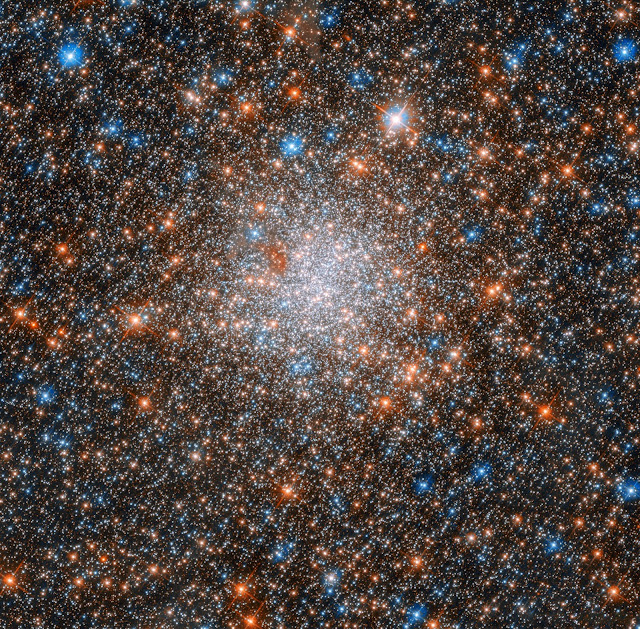
NASA PhotoNews: NGC 1898: Globular Cluster in the Large Magellanic Cloud Image Credit: ESA/Hubble & NASA Explanation: Jewels don't shine this bright -- only stars do. And almost every spot in this glittering jewel-box of an image from the Hubble Space Telescope is a star. Now some stars are more red than our Sun, and some more blue -- but all of them are much farther away. Although it takes light about 8 minutes to reach Earth from the Sun, NGC 1898 is so far away that it takes light about 160,000 years to get here. This huge ball of stars, NGC 1898, is called a globular cluster and resides in the central bar of the Large Magellanic Cloud (LMC) -- a satellite galaxy of our large Milky Way Galaxy. The featured multi-colored image includes light from the infrared to the ultraviolet and was taken to help determine if the stars of NGC 1898 all formed at the same time, or at different times. There are increasing indications that most globular clusters formed stars in stages,...

NASA PhotoNews: Cosmic Collision Forges Galactic Ring

Image
NASA PhotoNews: Cosmic Collision Forges Galactic Ring Image Credit: X-ray: Chandra (NASA, CXC, INAF, A. Wolter et al.); Optical: Hubble (NASA, STScI) Explanation: How could a galaxy become shaped like a ring? The rim of the blue galaxy pictured on the right is an immense ring-like structure 150,000 light years in diameter composed of newly formed, extremely bright, massive stars. That galaxy, AM 0644-741, is known as a ring galaxy and was caused by an immense galaxy collision. When galaxies collide, they pass through each other -- their individual stars rarely come into contact. The ring-like shape is the result of the gravitational disruption caused by an entire small intruder galaxy passing through a large one. When this happens, interstellar gas and dust become condensed, causing a wave of star formation to move out from the impact point like a ripple across the surface of a pond. The likely intruder galaxy is on the left of this combined image from Hubble (visible) and Chan...

NASA PhotoNews: Mont Blanc, Meteor, and Milky Way

Image
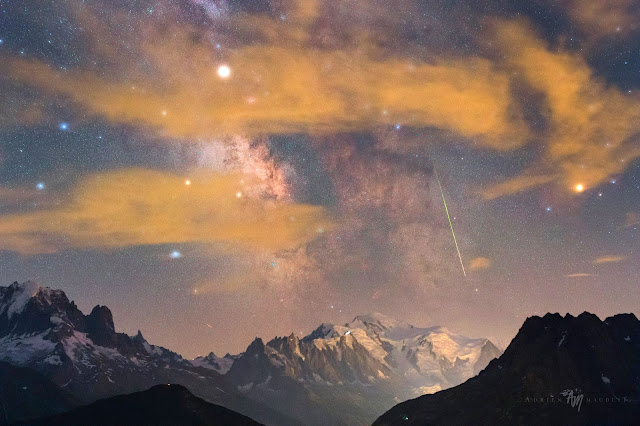
NASA PhotoNews: Mont Blanc, Meteor, and Milky Way Image Credit & Copyright: Adrien Mauduit Explanation: Snowy Mont Blanc is near the center of this atmospheric night skyscape. But high, thin clouds fogged the skies at the photographer's location, looking south toward Europe's highest peak from the southern Swiss Alps. Still, the 13 second exposure finds the faint star fields and dark rifts of the Milky Way above the famous white mountain. Bloated by the mist, bright planet Saturn and Antares (right), alpha star of Scorpius, shine through the clouds to flank the galaxy's central bulge. The high-altitude scene is from the rewarding night of August 12/13, so it also includes the green trail of a Perseid meteor shooting along the galactic plane. === #NASA #space #photonews 18.09.15

NASA PhotoNews: Comet, Clusters and Nebulae

Image
NASA PhotoNews: Comet, Clusters and Nebulae Image Credit & Copyright: Mohammad Nouroozi Explanation: Bright enough for binocular viewing Comet 21P / Giacobini-Zinner stands out, even in this deep telephoto mosaic of the star cluster and nebula rich constellation Auriga the Charioteer. On the night of September 9 its greenish coma and diffuse tail contrast with the colorful stars and reddish emission nebulae in the almost 10 degree field of view along the Milky Way. The comet was near its perihelion and closest approach to Earth, about 200 light-seconds away. Riding across the distant background just above the comet's tail are well-known Auriga star clusters M38 (left of center) and M36 (toward the right) about 4,000 light-years away. At the top left, emission region IC 405 is only 1,500 light-years distant, more dramatically known as the Flaming Star Nebula. To its right lies IC 410, 12,000 light-years away and famous for its star-forming cosmic tadpoles. A child of our ...

NASA PhotoNews: Milky Way over Troll's Tongue

Image
NASA PhotoNews: Milky Way over Troll's Tongue Image Credit & Copyright: Ruslan Merzlyakov (RMS Photography) Explanation: You have to take a long hike to see the Troll's Tongue -- ten hours over rocky terrain. And in this case, it took three trips to capture the landform below a clear night sky. Trolltunga itself is a picturesque rock protrusion extending about 700 meters over mountainous cliffs near Lake Ringedalsvatnet in Norway. The overhang is made of billion-year-old Precambrian bedrock that was carved out by glaciers during an ice-age about 10,000 years ago. The featured picture is a composite of two exposures, a 15-second image of the foreground Earth followed 40 minutes later by an 87-second exposure of the background sky. Thousands of discernable stars dot the backdrop starscape in addition to billions of unresolved stars in the nearly vertical band of our Milky Way Galaxy.  === #NASA #space #photonews

M1: The Crab Nebula from Hubble

Image
M1: The Crab Nebula from Hubble Image Credit: NASA, ESA, Hubble, J. Hester, A. Loll (ASU) Explanation: This is the mess that is left when a star explodes. The Crab Nebula, the result of a supernova seen in 1054 AD, is filled with mysterious filaments. The filaments are not only tremendously complex, but appear to have less mass than expelled in the original supernova and a higher speed than expected from a free explosion. The featured image, taken by the Hubble Space Telescope, is presented in three colors chosen for scientific interest. The Crab Nebula spans about 10 light-years. In the nebula's very center lies a pulsar: a neutron star as massive as the Sun but with only the size of a small town. The Crab Pulsar rotates about 30 times each second. Original link: https://apod.nasa.gov/apod/ap180909.html === #NASA #space #photonews

Along the Western Veil

Image
Along the Western Veil Image Credit & Copyright: Data - Steve Milne & Barry Wilson, Processing - Steve Milne Explanation: Delicate in appearance, these filaments of shocked, glowing gas, are draped across planet Earth's sky toward the constellation of Cygnus. They form the western part of the Veil Nebula. The Veil Nebula itself is a large supernova remnant, an expanding cloud born of the death explosion of a massive star. Light from the original supernova explosion likely reached Earth over 5,000 years ago. Blasted out in the cataclysmic event, the interstellar shock wave plows through space sweeping up and exciting interstellar material. The glowing filaments are really more like long ripples in a sheet seen almost edge on, remarkably well separated into atomic hydrogen (red) and oxygen (blue-green) gas. Also known as the Cygnus Loop, the Veil Nebula now spans nearly 3 degrees or about 6 times the diameter of the full Moon. While that translates to over 70 light-yea...