Posts

NASA PhotoNews: Swimming on Jupiter

Image
NASA PhotoNews: Swimming on Jupiter Image Credit: NASA, JPL-Caltech, SwRI, MSSS; Processing & License: Brian Swift, Sean Doran Explanation: On October 29, the Juno spacecraft once again dove near the turbulent Jovian cloud tops. Its 16th orbital closest approach or perijove passage, brought Juno within 3,500 kilometers of the Solar System's largest planetary atmosphere. These frames, recorded by JunoCam while the spacecraft cruised 20 - 50 thousand kilometers above the planet's middle southern latitudes, seem to follow a swirling cloud shaped remarkably like a dolphin. Swimming along Jupiter's darker South South Temperate Belt, this dolphin is itself planet-sized though, some thousands of kilometers across. Junos next passage was on December 21, 2018. === #NASA #space #photonews 18.12.14

NASA PhotoNews: M43 - Orion Falls

Image
NASA PhotoNews: M43: Orion Falls Image Credit & Copyright: Zhuoqun Wu, Chilescope Telescope 2 Explanation: Is there a waterfall in Orion? No, but some of the dust in M43 appears similar to a waterfall on Earth. M43, part of the Orion Molecular Cloud Complex, is the often imaged but rarely mentioned neighbor of the more famous M42. M42, which includes many bright stars from the Trapezium cluster, lies above the featured scene. M43 is itself a star forming region and although laced with filaments of dark dust, is composed mostly of glowing hydrogen. The entire Orion field, located about 1600 light years away, is inundated with many intricate and picturesque filaments of dust. Opaque to visible light, dark dust is created in the outer atmosphere of massive cool stars and expelled by a strong outer wind of protons and electrons. === #NASA #space #photonews 18.12.12

NASA PhotoNews: Arp 188 and the Tadpole's Tail

Image
NASA PhotoNews: Arp 188 and the Tadpole's Tail Image Credit: Hubble Legacy Archive, ESA, NASA; Processing: Faus Márquez (AAE) Explanation: Why does this galaxy have such a long tail? In this stunning vista, based on image data from the Hubble Legacy Archive, distant galaxies form a dramatic backdrop for disrupted spiral galaxy Arp 188, the Tadpole Galaxy. The cosmic tadpole is a mere 420 million light-years distant toward the northern constellation of the Dragon (Draco). Its eye-catching tail is about 280 thousand light-years long and features massive, bright blue star clusters. One story goes that a more compact intruder galaxy crossed in front of Arp 188 - from right to left in this view - and was slung around behind the Tadpole by their gravitational attraction. During the close encounter, tidal forces drew out the spiral galaxy's stars, gas, and dust forming the spectacular tail. The intruder galaxy itself, estimated to lie about 300 thousand light-years behind the ...

NASA PhotoNews: Sound and Light Captured by Mars InSight

Image
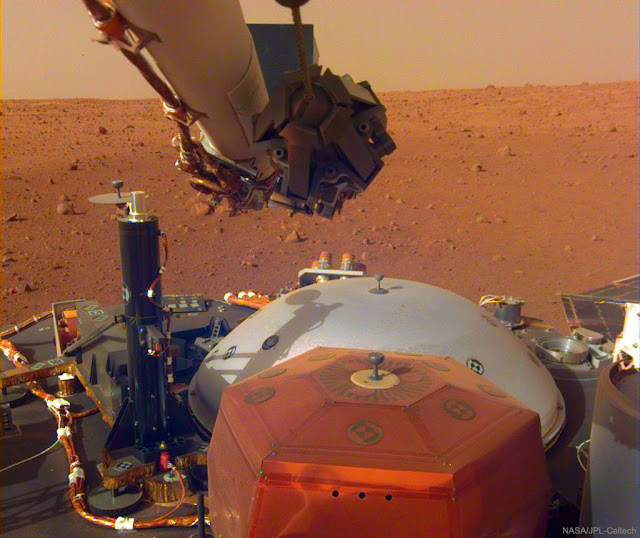
NASA PhotoNews: Sound and Light Captured by Mars InSight Image Credit: NASA/JPL-Caltech Explanation: Your arm on Mars has unusual powers. For one thing it is nearly 2 meters long, has a scoop and grapple built into its hand, and has a camera built into its forearm. For another, it will soon deploy your ear -- a sensitive seismometer that will listen for distant rumblings -- onto the surface of Mars. Your SEISmomet-ear is the orange box in the foreground, while the gray dome behind it will be its protective cover. Your arm is attached to the InSight robotic lander that touched down on Mars two weeks ago. Somewhat unexpectedly, your ear has already heard something -- slight vibrations caused by the Martian wind flowing over the solar panels. Light from the Sun is being collected by the solar panels, part of one being visible on the far right. Actually, at the present time, you have two arms operating on Mars, but they are separated by about 600 kilometers. That's because you...

NASA PhotoNews: The Fairy of Eagle Nebula

Image
NASA PhotoNews: The Fairy of Eagle Nebula Image Credit: NASA, ESA, The Hubble Heritage Team, (STScI/AURA) Explanation: The dust sculptures of the Eagle Nebula are evaporating. As powerful starlight whittles away these cool cosmic mountains, the statuesque pillars that remain might be imagined as mythical beasts. Featured here is one of several striking dust pillars of the Eagle Nebula that might be described as a gigantic alien fairy. This fairy, however, is ten light years tall and spews radiation much hotter than common fire. The greater Eagle Nebula, M16, is actually a giant evaporating shell of gas and dust inside of which is a growing cavity filled with a spectacular stellar nursery currently forming an open cluster of stars. This great pillar, which is about 7,000 light years away, will likely evaporate away in about 100,000 years. The featured image in scientifically re-assigned colors was released in 2005 as part of the fifteenth anniversary celebration of the launch of...

NASA PhotoNews: IC 1871. Inside the Soul Nebula

Image
NASA PhotoNews: IC 1871. Inside the Soul Nebula Image Credit & Copyright: Mark Hanson Explanation: This cosmic close-up looks deep inside the Soul Nebula. The dark and brooding dust clouds on the left, outlined by bright ridges of glowing gas, are cataloged as IC 1871. About 25 light-years across, the telescopic field of view spans only a small part of the much larger Heart and Soul nebulae. At an estimated distance of 6,500 light-years the star-forming complex lies within the Perseus spiral arm of our Milky Way Galaxy, seen in planet Earth's skies toward the constellation Cassiopeia. An example of triggered star formation, the dense star-forming clouds of IC 1871 are themselves sculpted by the intense winds and radiation of the region's massive young stars. The featured image appears mostly red due to the emission of a specific color of light emitted by excited hydrogen gas. === #NASA #space #photonews 18.11.28

NASA PhotoNews: Phobos: Doomed Moon of Mars

Image
NASA PhotoNews: Phobos: Doomed Moon of Mars Image Credit: Viking Project, JPL, NASA; Mosaic Processing: Edwin V. Bell II (NSSDC/Raytheon ITSS) Explanation: This moon is doomed. Mars, the red planet named for the Roman god of war, has two tiny moons, Phobos and Deimos, whose names are derived from the Greek for Fear and Panic. The origin of the Martian moons is unknown, though, with a leading hypothesis holding that they are captured asteroids. The larger moon, at 25-kilometers across, is Phobos, and is indeed seen to be a cratered, asteroid-like object in this false-colored image mosaic taken by the robotic Viking 1 mission in 1978. A recent analysis of the unusual long grooves seen on Phobos indicates that they may result from boulders rolling away from the giant impact that created the crater on the upper left: Stickney Crater. Phobos orbits so close to Mars - about 5,800 kilometers above the surface compared to 400,000 kilometers for our Moon - that gravitational tidal force...

Shipwreck at Moonset

Image
Shipwreck at Moonset Image Credit & Copyright: Vikas Chander Explanation: A crescent Moon is about to sink under the western horizon in this sea and night skyscape. The atmospheric photo was taken on September 11 from the desert shore along the Skeleton Coast of Namibia. So close to moonset, the moonlight is reddened and dimmed by the low, long line-of-sight across the Atlantic. But near the center of the frame Venus still shines brightly, its light reflected in calm ocean waters. The celestial beacon above the brilliant evening star is bright planet Jupiter. Namibia's Skeleton Coast was so named for the many seal and whale bones that were once strewn along the shoreline. In more recent times it's better known for shipwrecks. === #NASA #space #photonews 18.11.24

Good Morning Leonid!

Image
Good Morning Leonid! Image Credit & Copyright: Stephane Vetter (Nuits sacrées), TWAN Explanation: On November 17, just an hour before sunrise, this bright and colorful meteor flashed through clear predawn skies. Above a sea of clouds this striking autumn morning's moment was captured from Hochblauen, a prominent 1165 meter high summit in southern Germany's Black Forest. Shining through the twilight, Sirius as well as the familiar stars of Orion are recognizable near the southwestern horizon, and the meteor seems headed right for the hunter's belt and sword. Still, as part of the annual Leonid meteor shower, the meteor trail does point back to the shower's radiant. The constellation Leo is high above the horizon and off the top left of the frame. === #NASA #space #photonews 18.11.23

NASA PhotoNews: Portrait of NGC 281

Image
NASA PhotoNews: Portrait of NGC 281 Image Credit & Copyright: Jeremiah Roth Explanation: Look through the cosmic cloud cataloged as NGC 281 and you might miss the stars of open cluster IC 1590. Still, formed within the nebula that cluster's young, massive stars ultimately power the pervasive nebular glow. The eye-catching shapes looming in this portrait of NGC 281 are sculpted dusty columns and dense Bok globules seen in silhouette, eroded by intense, energetic winds and radiation from the hot cluster stars. If they survive long enough, the dusty structures could also be sites of future star formation. Playfully called the Pacman Nebula because of its overall shape, NGC 281 is about 10,000 light-years away in the constellation Cassiopeia. This sharp composite image was made through narrow-band filters. It combines emission from the nebula's hydrogen and oxygen atoms to synthesize red, green, and blue colors. The scene spans well over 80 light-years at the estimated ...

NASA PhotoNews: Swirls and Colors on Jupiter from Juno

Image
NASA PhotoNews:  Swirls and Colors on Jupiter from Juno Image Credit: NASA, Juno, SwRI, MSSS; Processing & License: Matt Brealey, Seán Doran Explanation: What creates the colors in Jupiter's clouds? No one is sure. The thick atmosphere of Jupiter is mostly hydrogen and helium, elements which are colorless at the low temperatures of the Jovian cloud tops. Which trace elements provide the colors remains a topic of research, although small amounts of ammonium hydrosulfide are one leading candidate. What is clear from the featured color-enhanced image -- and many similar images -- is that lighter clouds are typically higher up than darker ones. Pictured, light clouds swirl around reddish regions toward the lower right, while they appear to cover over some darker domains on the upper right. The featured image was taken by the robotic Juno spacecraft during its 14th low pass over Jupiter earlier this year. Juno continues in its looping elliptical orbit, swooping near the huge ...

NASA PhotoNews: Gibbous Moon beyond Swedish Mountain

Image
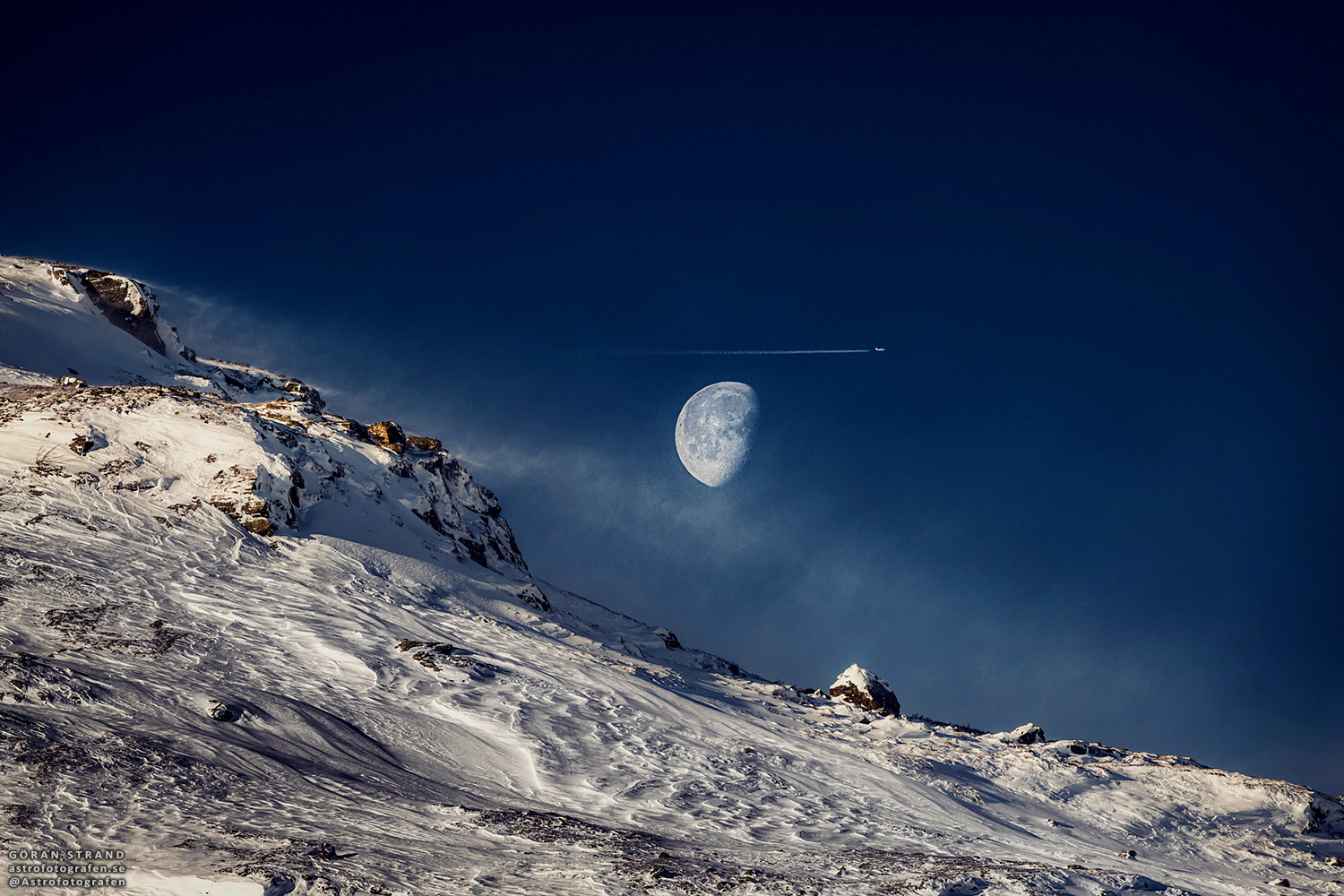
NASA PhotoNews: Gibbous Moon beyond Swedish Mountain Image Credit & Copyright: Göran Strand Explanation: This is a gibbous Moon. More Earthlings are familiar with a full moon, when the entire face of Luna is lit by the Sun, and a crescent moon, when only a sliver of the Moon's face is lit. When more than half of the Moon is illuminated, though, but still short of full illumination, the phase is called gibbous. Rarely seen in television and movies, gibbous moons are quite common in the actual night sky. The featured image was taken in Jämtland, Sweden near the end of last month. That gibbous moon turned, in a few days, into a crescent moon, and then a new moon, then back to a crescent, and a few days ago back to gibbous. And this same gibbous moon is visible again tonight, leading up to the Full Beaver Moon that occurs Friday night. Setting up to capture a picturesque gibbous moonscape, the photographer was quite surprised to find an airplane, surely well in the foregrou...

NASA PhotoNews: The Tarantula Nebula

Image
NASA PhotoNews: The Tarantula Nebula Image Credit & Copyright: Peter Ward (Barden Ridge Observatory) Explanation: The Tarantula Nebula, also known as 30 Doradus, is more than a thousand light-years in diameter, a giant star forming region within nearby satellite galaxy the Large Magellanic Cloud. About 180 thousand light-years away, it's the largest, most violent star forming region known in the whole Local Group of galaxies. The cosmic arachnid sprawls across this spectacular view, composed with narrowband filter data centered on emission from ionized hydrogen atoms. Within the Tarantula (NGC 2070), intense radiation, stellar winds and supernova shocks from the central young cluster of massive stars, cataloged as R136, energize the nebular glow and shape the spidery filaments. Around the Tarantula are other star forming regions with young star clusters, filaments, and blown-out bubble-shaped clouds. In fact, the frame includes the site of the closest supernova in moder...

The Cave Nebula in Hydrogen, Oxygen, and Sulfur

Image
The Cave Nebula in Hydrogen, Oxygen, and Sulfur Image Credit & Copyright: Chuck Ayoub Explanation: What's inside this cosmic cave? A stellar nursery 10 light-years deep. The featured skyscape is dominated by dusty Sh2-155, the Cave Nebula. In the telescopic image, data taken through a narrowband filters tracks the nebular glow of hydrogen, oxygen, and sulfur, colors that together form the Hubble Palette. About 2,400 light-years away, the scene lies along the plane of our Milky Way Galaxy toward the royal northern constellation of Cepheus. Astronomical explorations of the region reveal that it has formed at the boundary of the massive Cepheus B molecular cloud and the hot, young stars of the Cepheus OB 3 association. The bright rim of ionized hydrogen gas is energized by radiation from the hot stars, dominated by the bright star just to the left of the cave entrance. Radiation driven ionization fronts are likely triggering collapsing cores and new star formation within. ...

NASA PhotoNews: The Lagoon Nebula is Stars, Gas, and Dust

Image
NASA PhotoNews: The Lagoon Nebula is Stars, Gas, and Dust Image Credit & Copyright: Nelson Ortega Explanation: The majestic Lagoon Nebula is filled with hot gas and the home for many young stars. Spanning 100 light years across while lying only about 5000 light years distant, the Lagoon Nebula is so big and bright that it can be seen without a telescope toward the constellation of the Archer (Sagittarius). Many bright stars are visible from NGC 6530, an open cluster that formed in the nebula only several million years ago. The greater nebula, also known as M8 and NGC 6523, is named "Lagoon" for the band of dust seen to the left of the open cluster's center. The featured image was taken in three colors with details are brought out by light emitted by Hydrogen. Star formation continues in the Lagoon Nebula as witnessed by the many dark dust-laden globules that exist there. === #NASA #space #photonews 18.11.12

NASA PhotoNews: Astronaut Exploring: An Apollo 15 Panorama

Image
NASA PhotoNews: Astronaut Exploring: An Apollo 15 Panorama Image Credit & Copyright: NASA, USGS, Apollo 15 Crew Explanation: What would it be like to explore the Moon? NASA's Apollo missions gave humans just this chance in the late 1960s and early 1970s. In particular, the Apollo 15 mission was dedicated to better understanding the surface of the Moon by exploring mountains, valleys, maria, and highlands. Astronauts David Scott and James Irwin spent nearly three days on the Moon while Alfred Worden orbited above in the Command Module. The mission, which blasted off from Earth on 1971 July 26, was the first to deploy a Lunar Roving Vehicle. Pictured in this digitally stitched mosaic panorama, David Scott, exploring his surroundings, examines a boulder in front of the summit of Mt. Hadley Delta. The shadow of James Irwin is visible to the right, while scrolling to the right will reveal a well-lit and diverse lunar terrain. The Apollo 15 mission returned about 76 kilograms...

NASA PhotoNews: NGC 6188: The Dragons of Ara

Image
NASA PhotoNews: NGC 6188: The Dragons of Ara Image Credit & Copyright: Tian Lee Explanation: Dark shapes with bright edges winging their way through dusty NGC 6188 are tens of light-years long. The emission nebula is found near the edge of an otherwise dark large molecular cloud in the southern constellation Ara, about 4,000 light-years away. Born in that region only a few million years ago, the massive young stars of the embedded Ara OB1 association sculpt the fantastic shapes and power the nebular glow with stellar winds and intense ultraviolet radiation. The recent star formation itself was likely triggered by winds and supernova explosions, from previous generations of massive stars, that swept up and compressed the molecular gas. With image data from the Chilescope Observatory, a false-color Hubble palette was used to create this gorgeous wide-field image and shows emission from sulfur, hydrogen, and oxygen atoms in red, green, and blue hues. The field of view spans ab...

NASA PhotoNews: Halo of the Cat's Eye

Image
NASA PhotoNews: Halo of the Cat's Eye Image Credit & Copyright: Data: Michael Joner (West Mountain Observatory, BYU), Romano Corradi (IAC), Hubble Legacy Archive - Processing: Robert Gendler Explanation: Not a Falcon 9 rocket launch after sunset, the Cat's Eye Nebula (NGC 6543) is one of the best known planetary nebulae in the sky. Its haunting symmetries are seen in the very central region of this composited picture, processed to reveal an enormous but extremely faint halo of gaseous material, over three light-years across. Made with data from ground- and space-based telescopes it shows the extended emission which surrounds the brighter, familiar planetary nebula. Planetary nebulae have long been appreciated as a final phase in the life of a sun-like star. But only more recently have some planetaries been found to have halos like this one, likely formed of material shrugged off during earlier active episodes in the star's evolution. While the planetary nebul...

NASA PhotoNews: NGC 1499: The California Nebula

Image
NASA PhotoNews: NGC 1499: The California Nebula Image Credit & Copyright: Bray Falls Explanation: There's even a California in space. Drifting through the Orion Arm of the spiral Milky Way Galaxy, this cosmic cloud by chance echoes the outline of California on the west coast of the United States. Our own Sun also lies within the Milky Way's Orion Arm, only about 1,500 light-years from the California Nebula. Also known as NGC 1499, the classic emission nebula is around 100 light-years long. On the featured image, the most prominent glow of the California Nebula is the red light characteristic of hydrogen atoms recombining with long lost electrons, stripped away (ionized) by energetic starlight. The star most likely providing the energetic starlight that ionizes much of the nebular gas is the bright, hot, bluish Xi Persei just to the right of the nebula. A regular target for astrophotographers, the California Nebula can be spotted with a wide-field telescope under a d...

NASA PhotoNews: Shells of Stars in Elliptical Galaxy PGC 42871

Image
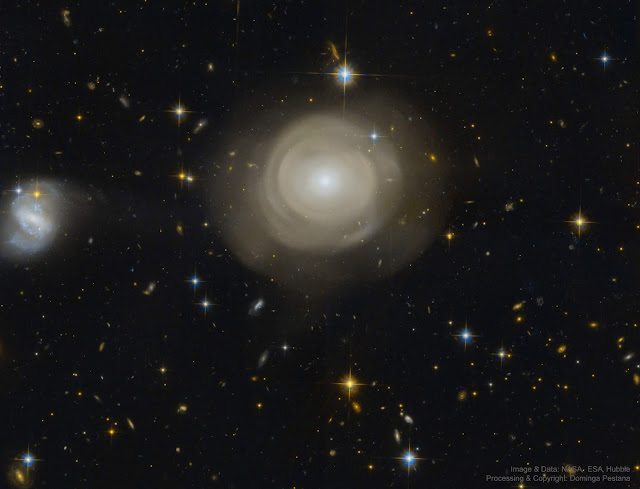
NASA PhotoNews: Shells of Stars in Elliptical Galaxy PGC 42871 Image Credit: Hubble Legacy Archive, NASA, ESA; Processing & Copyright: Domingo Pestana Explanation: How do galaxies grow? To help find out, the Hubble Space Telescope was deployed to image the unusual elliptical galaxy PGC 42871. How this galaxy came to be surrounded by numerous shells of stars may give clues about how it evolved. Embedded in the diffuse shells are massive globular clusters of stars -- stars which analyses show were born during three different epochs. This and other data indicate that PGC 42871 has been in at least two galactic collisions, at least one of which might have been with a former spiral galaxy. The remaining spiral galaxy on the far left is at the same distance as PGC 42871 and may have been involved in some of the collisions. PGC 42871 spans about 20 thousand light years and lies about 270 million light years away toward the constellation of Centaurus. === #NASA #space #photonews 18...